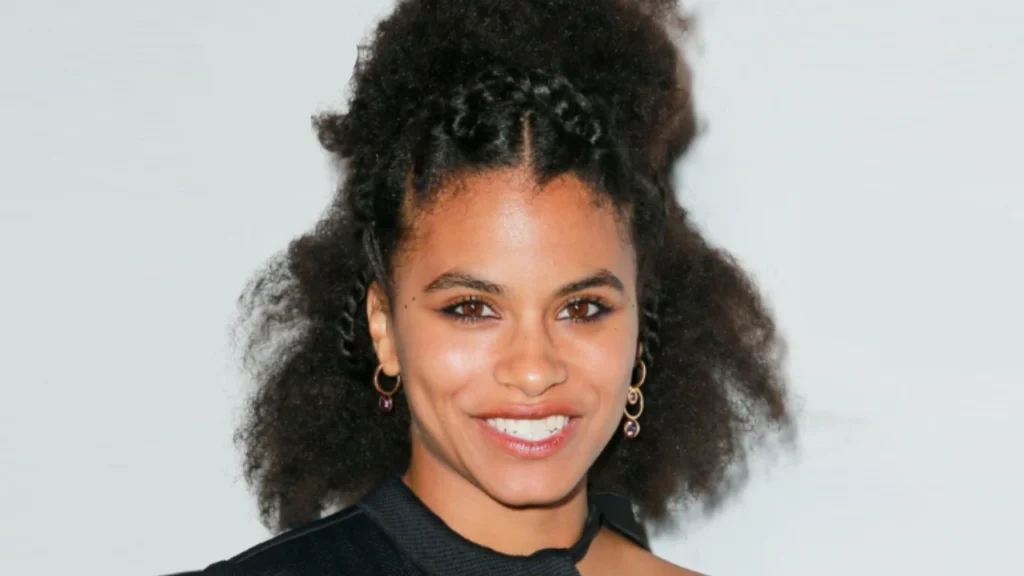
Zazie Beetz’s net worth is estimated between $3 million and $5 million as of September 2026, depending on which estimation model you follow. The German-American actress, born Zazie Olivia Beetz on June 1, 1991, in Berlin’s Mitte district, earned a Primetime Emmy nomination for her breakout role on FX’s Atlanta and has since appeared in billion-dollar franchises including Deadpool 2 and Joker.
Between mid-2025 and early 2026, she released four films: The Bad Guys 2, The Dutchman, Good Luck, Have Fun, Don’t Die, and They Will Kill You. One became a box office hit; another underperformed.
Together, they show how uneven pay and outcomes remain for an actor at her career stage, even one with billion-dollar credits already behind her.
Why Zazie Beetz’s Net Worth Remains Modest
Roughly 70 percent of Beetz’s income comes from television, about 25 percent from film, and the rest from endorsements, social media partnerships, and other ventures. TV contracts pay reliably year over year. Supporting roles in studio films, by contrast, rarely come with the backend deals that turn a single credit into major wealth.
In a 2018 interview, Beetz addressed this gap directly, noting that people assume everyone on screen is “super rich.” Still, she described herself as comfortable in her salary, adding that she flies economy when paying out of pocket.
Her starting point was modest, too. After graduating from Skidmore College in 2013 with a degree in French, she spent a year waiting tables before landing her first credited screen roles.
Breaking Down Beetz’s Career Earnings
Atlanta — The Launchpad
Beetz played Vanessa “Van” Keefer across all four seasons of FX’s Atlanta (2016–2022). For it, she earned a Primetime Emmy nomination for Outstanding Supporting Actress in a Comedy Series at the 70th Primetime Emmy Awards in 2018.
Created by Donald Glover, Atlanta won Peabody and Golden Globe awards and became a defining cultural text of its era. Six years on the show gave Beetz industry credibility a single blockbuster paycheck can’t provide.
Van’s biracial upbringing echoed Beetz’s own background as an Afro-German actress; notably, a season two episode set at a German cultural festival mirrors tensions Beetz has spoken about from her own childhood.
Her estimated annual income from this period is around $150,000, varying with project volume and negotiations. Even now, television remains her most dependable revenue stream — a pattern she’d return to in 2023 with a lead role in Full Circle (below).
Deadpool 2 (2018) — Entering the Blockbuster Arena
Director David Leitch cast Beetz as Domino in Deadpool 2, which went on to earn over $785 million worldwide. Her salary was never disclosed, but industry benchmarks put supporting performers at her profile between $100,000 and $500,000 for a role like this — a fixed number that doesn’t scale with box office.
The film also established a working relationship with Leitch, which led to another collaboration four years later.
Joker (2019) — A Billion-Dollar Puzzle
In Todd Phillips’ Joker, Beetz played Sophie Dumond, Arthur Fleck’s neighbor. The film cost $62.5 million to make, yet returned over $1.07 billion worldwide — the first R-rated film to cross that mark — and earned 11 Oscar nominations, with Joaquin Phoenix winning Best Actor.
Phoenix reportedly took a reduced $4.5 million upfront salary in exchange for backend points. Once the film crossed $1 billion, that deal reportedly brought his total Joker earnings to around $25 million. Phillips took an even larger risk, waiving his director’s fee entirely for a backend stake reportedly worth roughly $100 million once the film succeeded. Supporting cast members, by contrast, almost universally work on fixed fees with no backend stake unless it’s negotiated in advance.
| Actor | Role | Estimated Net Worth |
|---|---|---|
| Lady Gaga | Harley Quinn | ~$300 million |
| Joaquin Phoenix | Arthur Fleck / Joker | ~$80 million |
| Steve Coogan | Paddy Meyers | ~$25 million |
| Brendan Gleeson | Jackie Sullivan | ~$8 million |
| Catherine Keener | Maryanne Stewart | ~$8 million |
| Zazie Beetz | Sophie Dumond | ~$3–5 million |
In short, a supporting actor in a billion-dollar film doesn’t automatically see a proportional share of the profits — which is how Beetz can have a $1 billion credit without eight figures in her personal accounts.
Joker: Folie à Deux (2024)
Beetz returned as Sophie Dumond alongside Lady Gaga, whose estimated net worth of roughly $300 million dwarfs the rest of the cast’s. Unlike its predecessor, though, the sequel underperformed commercially. Whether that affected Beetz’s pay for the return isn’t publicly known.
The Prolific 2019
Beyond Joker, 2019 was a five-film year for Beetz: Steven Soderbergh’s High Flying Bird, the Jean Seberg biopic Seberg with Kristen Stewart, Noah Hawley’s Lucy in the Sky opposite Natalie Portman and Jon Hamm, and Babak Anvari’s Wounds with Dakota Johnson — spanning biographical drama, psychological horror, and science fiction. It marked the peak of her film-casting demand at that point in her career. Later, her relationship with Soderbergh would pay off again in 2023.
Beyond the Tentpoles
Throughout her career, Beetz has balanced franchise work with smaller, director-driven projects: Cathy Yan’s Dead Pigs, Edson Oda’s Sundance title Nine Days with Winston Duke, and Jaymes Samuel’s Netflix Western The Harder They Fall alongside Jonathan Majors, Idris Elba, Regina King, Delroy Lindo, and Lakeith Stanfield. Earlier credits include Josh Mond’s James White and Onur Tukel’s Applesauce.
In 2023, for instance, she led Steven Soderbergh’s mystery miniseries Full Circle — her second collaboration with the director after High Flying Bird. A lead role in a limited series like this pays better than a supporting film credit for comparable work, though without the box office upside of a franchise picture.
She also reunited with David Leitch on Bullet Train (2022), an ensemble led by Brad Pitt and Sandra Bullock that earned $239 million worldwide.
Voice Work, Animation, and the 2025–2026 Slate
Since 2021, Beetz has voiced Amber Bennett in Amazon’s Invincible, joined Netflix’s Big Mouth in 2023, and played Diane Foxington in DreamWorks’ The Bad Guys (2022) and its sequel. Alongside this, she also appeared in Netflix’s Black Mirror.
Voice acting pays less per session than live-action work, but recurring animated contracts offer something in return: predictable, multi-season income with shorter time commitments.
For instance, The Bad Guys 2 opened in August 2025 and grossed roughly $240 million worldwide against an $80 million budget, making it one of the better-performing films of her career.
Her three live-action releases from this stretch, however, had mixed results. The Dutchman, adapting Amiri Baraka’s 1964 play, premiered at SXSW in March 2025 and had a limited US release in January 2026. Similarly, Good Luck, Have Fun, Don’t Die, Gore Verbinski’s sci-fi comedy with Sam Rockwell and Juno Temple, premiered at Fantastic Fest in September 2025 and opened wide in February 2026 to a modest $9.7 million domestic gross. Meanwhile, They Will Kill You, a horror-comedy from Kirill Sokolov, gave Beetz her first lead role in a wide theatrical release: she plays Asia Reaves, an ex-convict searching for her missing sister. Even so, the film grossed just under $19.4 million worldwide against a $20 million budget, essentially breaking even before marketing costs. Critics, notably, were largely positive about her performance specifically, even where reviews of the film itself were mixed.
The gap between those two outcomes is instructive: leading a film doesn’t guarantee it performs, and a supporting voice role in a strong franchise can outearn a starring live-action credit at the box office.
Looking ahead, Beetz has Shelter in pre-production, with no confirmed release date. In the meantime, she and husband David Rysdahl appeared together at SXSW 2026 to support They Will Kill You‘s premiere.
Where the Numbers Come From
Celebrity Net Worth and The Richest place Beetz between $3 million and $5 million, while other outlets cite figures closer to $2 million. Some low-quality aggregator sites, meanwhile, cite numbers far outside that range with no visible sourcing; those aren’t reflected here. The remaining gap exists largely because net worth calculations factor in liquid assets, real estate, business interests, investments, and debts — none of which is publicly disclosed for Beetz.
With roughly 835,000 Instagram followers, third-party influencer-analytics estimates put her sponsored-post income at $9,000–$12,000 per month, or roughly $108,000–$148,000 annually. That’s a fraction of what some blanket influencer-earnings calculators suggest for accounts her size, since methodologies vary widely.
Still, the aggregate box office footprint is clear. Her combined film projects — Deadpool 2, Joker, Bullet Train, The Harder They Fall, The Bad Guys films, and others — have generated well over $2 billion in worldwide theatrical revenue, a figure that coexists comfortably with a mid-range personal net worth given how Hollywood structures pay below the marquee name.
Sleepy Poppy Productions — Building Beyond Acting
Together with her husband, actor and writer David Rysdahl, Beetz co-founded a production company called Sleepy Poppy. Rysdahl’s own credits include Oppenheimer and Fargo. The couple describes the company as:
“A place where humans can feel like they are playing in a sandbox of creativity. A place where storytellers can embrace their true, authentic selves while exploring story with joy, passion, wonder, and humility.”
Its most publicly discussed project is a modern retelling of Rapunzel, with Beetz attached to star as a princess whose defining feature is a giant afro rather than the traditional golden hair.
For actors at this stage, producing credits like these unlock development fees and backend participation on greenlit projects — essentially, a way to generate material rather than wait for the right role.
Beyond the boardroom, Beetz and Rysdahl have also appeared on screen together multiple times: Dead Pigs (2018), Nine Days (2020), and the Black Mirror episode “Mazey Day.”
The Background That Shapes Everything
Zazie Olivia Beetz was born in Berlin’s Mitte neighborhood. Her father, Thomas Beetz, grew up in East Germany and emigrated to the US around 1990, working as a janitor in New York while training as a cabinet maker. Her mother, Michelle, is an African-American social worker from New York; she’d felt increasingly isolated as one of few people of color in Berlin, which eventually prompted the family’s move to Manhattan.
Her parents separated when she was young, and by age eight, she had settled permanently in Manhattan’s Washington Heights. Growing up, she spoke both German and English at home, and has said she considers her German identity essential to who she is. Even so, she’s spoken about the confusion of growing up biracial, recalling the question that haunted her adolescence: “Am I not Black enough?”
Artistic Instincts
She trained at the Harlem School of the Arts and in community theater before specializing in theater at LaGuardia Arts High School, whose alumni include Al Pacino, Timothée Chalamet, and Nicki Minaj. From there, she went on to Skidmore College, graduating in 2013 with a degree in French.
Growing up, her artistic heroes were Josephine Baker, Nina Simone, and Billie Holiday.
Relationship
She’s been with fellow actor David Rysdahl since 2014, when the two met at an acting workshop. They got engaged in May 2022 and married in September 2023 at Salveymühle, a countryside venue in Germany’s Uckermark region, in an Alice in Wonderland-themed ceremony. Notably, the couple never publicly announced the wedding; it only surfaced after their wedding planner shared photos online. By December 2023, Beetz was calling Rysdahl her “model husband” on Instagram. Her height is listed at 5 feet 6 inches.
What Her Financial Profile Tells Us About Hollywood
Landing a role in a billion-dollar franchise doesn’t automatically generate the wealth that public assumptions project onto it. Instead, Beetz’s path ran through years of unpaid early work, a career-defining TV role, then a gradual layering of film credits, voice work, and eventually a headlining miniseries and a production company. There was no single overnight windfall along the way, and no guarantee that a lead role outperforms a supporting one — as They Will Kill You and The Bad Guys 2 showed within months of each other.
Actors at her tier — recognizable, critically respected, consistently employed, but not headlining $200 million tentpoles under their own name — also carry career overhead that eats into gross income. Agents take 10 percent, managers another 10 to 15 percent, publicists charge retainers, and state taxes in California or New York take a further share.
Conclusion
Zazie Beetz’s net worth is estimated between $3 million and $5 million as of September 2026. In that time, she has appeared in projects worth over $2 billion at the global box office, released four films in under a year — a hit, a flop, and two in between — and now runs a production company with her husband, all while maintaining television as her primary income source.