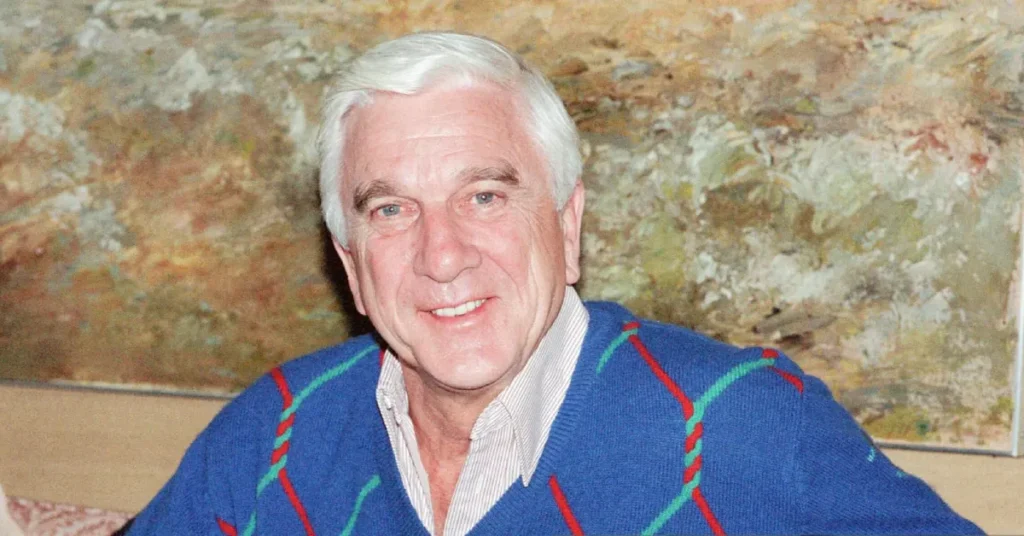
Leslie Nielsen’s net worth at death sat somewhere between $10 million and $20 million, built across six decades of film and television work. He earned the bulk of that fortune from comedy—specifically Airplane! and The Naked Gun franchise—but his path to that wealth started long before anyone ever laughed at his deadpan delivery.
Estimates vary depending on the source and what gets counted. Property holdings, residuals, estate privacy, and different calculation methods all play a role. What’s not in dispute is that Nielsen turned a late-career genre switch into serious money.
Leslie Nielsen Net Worth
Most credible estimates place Leslie Nielsen’s net worth between $10 million and $20 million at the time of his death in 2010. Celebrity Net Worth puts the figure at around $20 million, while other sources track closer to $10 million. The gap exists because nobody uses the same method. Some calculations rely on publicly known film contracts and backend deals. Others factor in real estate holdings, book income, and ongoing licensing from a filmography that continues generating revenue through cable syndication and streaming platforms.
Estate records in Florida—where Nielsen spent his final years—aren’t fully public, which keeps the exact figure uncertain. He worked steadily until near the end of his life, but he also lived comfortably, maintained homes in multiple states, and supported his family. The real number probably falls somewhere between the two estimates.
How He Earned It — The Money Story
Nielsen didn’t build his wealth through one blockbuster deal. He built it through persistence—decades of steady paychecks that turned into dramatically bigger paychecks once Hollywood figured out what he could really do.
The Working Actor Years (1950s–1970s)
Born in Regina, Saskatchewan in 1926, Nielsen grew up in a household shaped by immigration. His father Ingvard came from Denmark, his mother Mabel from Wales. His childhood was difficult—his father was abusive to the family, and Nielsen carried those early years with him. After high school, he enlisted in the Royal Canadian Air Force at 17, near the end of World War II. Once discharged, he drifted toward radio work, studying at the Lorne Greene Academy of Radio Arts in Toronto before earning a scholarship to the Neighborhood Playhouse in New York City. That move set his trajectory toward acting.
The 1950s represented television’s golden age, and Nielsen threw himself into it headfirst. He appeared in over 50 television productions in 1950 alone—a staggering volume that sounds impressive until you realize how little those early roles actually paid. The money was thin, so he supplemented his income with documentary narration and commercial voiceover work.
MGM Signed
Film offered better paydays. MGM signed him, and he landed roles in Forbidden Planet (1956)—a science fiction landmark that still generates residuals today—and Tammy and the Bachelor. He left MGM in 1959 to pursue independent work, taking on the Disney miniseries The Swamp Fox and steadily building a reputation as a dependable dramatic leading man throughout the 1960s. His role in The Poseidon Adventure (1972) placed him in one of the decade’s highest-grossing disaster films. He kept taking dramatic work through the 1970s, with his final serious role arriving in City on Fire in 1979—a clean ending point before everything changed.
His older brother Erik, meanwhile, carved out an entirely different kind of prominence—serving in the Canadian Parliament and eventually rising to Deputy Prime Minister. The Nielsen family clearly produced driven people.
Across all those dramatic years, Nielsen earned a respectable living without ever becoming a major star. He wasn’t wealthy, but he was working constantly—over 100 films and more than 1,500 television episodes across his career, playing well over 220 distinct characters. That volume of work created a sprawling foundation of income streams that would pay off far more handsomely than he could have anticipated.
The Comedy Pivot — Where the Real Money Started (1980s)
In 1980, at age 54, everything changed with a single casting decision. Directors Jim Abrahams and brothers David and Jerry Zucker—known collectively as the ZAZ team—needed someone for their parody film Airplane! who could deliver the most absurd lines imaginable with absolute, unflinching seriousness. They specifically sought dramatic actors, not comedians. Nielsen landed the role of Dr. Shirley Rumack, and his stone-faced line delivery transformed the part into comedy legend. “Surely you can’t be serious.” “I am serious. And don’t call me Shirley.” That exchange became one of the most quoted moments in film comedy history.
The financial performance was staggering. Airplane! cost roughly $3.5 million to produce and earned over $171 million worldwide—a return on investment that stunned the industry. Nielsen didn’t necessarily get rich from that single project alone, but it completely redefined his market value. Studios suddenly understood that this dramatic actor could sell comedy tickets at a massive scale.
The same creative team then built a television series around him. Police Squad! debuted in 1982 with Nielsen as Detective Frank Drebin—a bumbling, utterly sincere police officer navigating a world of absurd criminal activity. The performance earned him an Emmy nomination for Outstanding Lead Actor in a Comedy Series, but CBS pulled the show after just six episodes. The audience that found it loved it fiercely; there just weren’t enough of them tuning in on Friday nights.
The Naked Gun
Cancellation didn’t kill Frank Drebin. In 1988, the character was brought back for The Naked Gun: From the Files of Police Squad!, a feature film that became a box office hit. Two sequels followed—The Naked Gun 2½: The Smell of Fear (1991) and The Naked Gun 33⅓: The Final Insult (1994). Together, the three films generated hundreds of millions in worldwide revenue. Nielsen earned upfront salaries plus backend profit participation on each installment, and he continued to collect residual payments every time the films aired on television, were sold through home video, or were licensed to cable networks. Those checks kept arriving for decades.
The franchise money was transformative. It moved Nielsen from “working actor” into genuinely wealthy territory. He also capitalized on the brand by publishing The Naked Truth in 1993—a fictitious, humor-driven autobiography built on the franchise’s name recognition.
The 1990s and 2000s — Sustaining the Momentum
After the Naked Gun trilogy, Nielsen leaned further into the parody genre that had made him rich. Films like Spy Hard (1996) and Wrongfully Accused (1998) attracted decent audiences but couldn’t match the critical or commercial heights of his earlier work. The pattern was consistent: audiences enjoyed watching Nielsen do his signature thing, but the material surrounding him had weakened.
A minor resurgence arrived when he joined the Scary Movie franchise, appearing in the third installment (2003) and its sequel (2006). These films introduced him to an entirely younger demographic and added meaningfully to his lifetime earnings. He continued working through the late 2000s with projects like Superhero Movie (2008) and Stan Helsing (2009), along with a hosting role on the Discovery Channel’s Doctor*Ology.
None of these later projects matched the Naked Gun paydays, but they kept him active and earning. Combined with the ongoing residual income from his classic catalog, the revenue never really stopped flowing—during his life or after it.
What Made Him Valuable — The Deadpan Factor
Nielsen’s financial success was inseparable from his comedic delivery. Deadpan—playing absurd situations with complete, poker-faced sincerity—wasn’t just his style. It was his entire comedic identity. And it worked so well precisely because of his dramatic background. Audiences who remembered him from Forbidden Planet and The Poseidon Adventure found it exponentially funnier watching him treat ridiculous scenarios with the same gravity he once brought to serious roles.
That approach made him uniquely bankable in the parody genre. Directors didn’t need him to be conventionally funny. They needed him to be completely, unshakably serious while chaos erupted around him. He delivered that better than anyone in the history of the genre, and the box office results reflected it consistently.
There’s a lesser-known dimension worth noting. Nielsen was legally deaf for most of his adult life and wore hearing aids throughout his career. Some observers have drawn a connection between his hearing loss and his distinctive flat vocal quality—the same quality that became his comedic trademark. He supported the Better Hearing Institute throughout his life and spoke openly about his disability, using his public platform to raise awareness rather than treating it as a limitation.
Real Estate — A Significant Piece of the Picture
Property holdings made up a meaningful portion of Nielsen’s overall wealth. For over 50 years, he owned a home in the Hollywood Hills, perched on roughly an acre of elevated land. He sold that property in 2004 for $1.9 million. The buyer subsequently demolished the original structure and built a roughly 9,000-square-foot modern mansion on the lot—a property that later appeared on the HBO series Ballers and was at one point listed for $22 million. It’s a striking illustration of how much Los Angeles real estate appreciated during the decades he held it.
He also previously owned a home in Beverly Hills during an earlier phase of his career. In his final years, he split time between a residence in Paradise Valley, Arizona, and an oceanfront condominium on the 28th floor of a building in Fort Lauderdale, Florida. The Fort Lauderdale property was where he lived with his fourth wife, Barbaree Earl, at the time of his death.
These real estate assets—situated in prime California and Florida markets—likely appreciated significantly over the decades Nielsen held them, contributing to the upper range of net worth estimates and forming a substantial component of his estate.
Personal Life and Family
Nielsen married four times over the course of his life. His first marriage to nightclub singer Monica Boyar lasted from 1950 to 1956. His second marriage, to Alisande Ullman, spanned from 1958 to 1973—the longest of his first three unions—and produced two daughters, Maura and Thea. A brief third marriage to Brooks Oliver ran from 1981 to 1983. In 2001, he married Barbaree Earl, and they remained together until his death.
His daughters Maura and Thea, from his marriage to Ullman, are among the likely beneficiaries of his estate alongside Barbaree. No public disputes over the estate have surfaced, suggesting the transfer was handled privately and smoothly—a notable contrast to many celebrity estates that devolve into prolonged and public court battles.
Off-screen, Nielsen was known for his love of golf and his fondness for elaborate practical jokes on friends and colleagues. Despite his enormous public fame in later years, he maintained a relatively private personal life.
Awards and Industry Recognition
Nielsen accumulated meaningful recognition over his career, with most major honors arriving in the later decades when his comedy work drew attention back to his broader body of contributions:
- Emmy Nomination — Outstanding Lead Actor in a Comedy Series (1982) for Police Squad!
- Hollywood Walk of Fame Star (1988) — awarded the same year the first Naked Gun film premiered, marking his arrival as a mainstream comedy force.
- UCLA Jack Benny Award (1995) — recognizing sustained excellence in comedy.
- Canada’s Walk of Fame Induction (2001) — formal recognition from his birth country.
- Officer of the Order of Canada (2002) — one of Canada’s highest civilian honors, awarded for contributions to the performing arts.
- ACTRA Award of Excellence (2003) — peer recognition from the Alliance of Canadian Cinema, Television and Radio Arts.
These honors reflected something broader than individual performances. They acknowledged a career that crossed genres, spanned decades, and earned respect in two countries’ entertainment industries.
Estate, Death, and What Came After
Leslie Nielsen died on November 28, 2010, at Holy Cross Hospital in Fort Lauderdale, Florida. He was 84 years old. The cause was acute pneumonia. He was interred at Evergreen Cemetery in Fort Lauderdale.
He left behind his wife Barbaree and his two daughters, Maura and Thea. Public details about the estate remain limited—no court filings, no public disputes, no drawn-out legal proceedings. The transfer appears to have been handled with the same quiet efficiency that characterized his personal life.
What continues is the income. Nielsen’s most celebrated films—Airplane!, the three Naked Gun installments, and much of his extensive television catalog—still air regularly on cable networks and remain available across major streaming platforms. Under standard SAG-AFTRA residual agreements, performers and their estates earn payments each time their work is broadcast, streamed digitally, or sold through home video formats. For a catalog as popular and frequently replayed as Nielsen’s, those payments represent a meaningful and ongoing revenue stream. His estate likely continues earning from these sources well into the present day.
Why Estimates Differ — A Quick Explainer
Net worth calculations for any deceased celebrity involve a significant degree of guesswork. Public records may reveal property transactions and certain contract details, but the majority of financial information stays locked behind estate privacy. Different sources make different assumptions about residual income, investment returns, and spending patterns accumulated over a 60-year career.
Some estimates attempt to reverse-engineer backend payments from known box office grosses, but the exact profit-sharing percentages Nielsen negotiated remain private. Licensing deals for his image and voice generate additional income that’s nearly impossible to quantify from outside. Estate taxes and legal costs also reduce the final amount ultimately passed to heirs.
The $10 million to $20 million range acknowledges this uncertainty honestly. Both figures are reasonable given what’s publicly known about his career earnings, property holdings, and the enduring commercial value of his filmography. The precise number may never be confirmed publicly—and it matters less than understanding the financial architecture behind a remarkably long and productive career in entertainment.
Legacy Beyond the Numbers
Nielsen’s lasting impact extends well past any bank statement. He proved that an actor could completely reinvent himself after 50 and achieve greater financial success in the new identity than the original one. That kind of late-career transformation is vanishingly rare in Hollywood, where careers typically peak in the thirties and gradually decline from there.
His deadpan approach to comedy shaped an entire generation of performers and filmmakers working in the parody and spoof genre. The films he anchored—particularly Airplane! and the Naked Gun series—remain among the most frequently referenced comedies in popular culture, with lines like “Don’t call me Shirley” still quoted and recognized decades after their release.
The franchise’s cultural durability has been further demonstrated by its continuation beyond Nielsen’s lifetime. In 2025, The Naked Gun was rebooted with Liam Neeson in the role of Frank Drebin Jr.—a direct acknowledgment that the comedic world Nielsen helped create still carries genuine commercial and audience value for modern viewers.
Nielsen built a meaningful fortune doing something he wasn’t even known for during the first half of his career. He made millions of people laugh, and he earned well while doing it. The financial figures tell one version of that story. The lasting cultural footprint—the catchphrases that entered everyday language, the deadpan style that became a comedy benchmark, the films that still make people laugh on a random Tuesday night—tells another, more important one.