Rob Beckett’s estimated net worth sits at approximately £6 million heading into 2026 — a figure that places the gap-toothed comedian from South East London firmly among Britain’s top-earning comedy performers. Translated into dollars, that is roughly $7.5 million, secured through a career spanning stand-up stages, primetime television, bestselling podcasts, and a quietly profitable production company.
The number originates from a detailed analysis of Companies House records, where Beckett’s entertainment company, Peggle Productions, shows net assets approaching £6 million. An investigation by The Sun that examined filings from the UK’s biggest comedy names placed Beckett sixth on the national wealth leaderboard — behind Peter Kay, Ricky Gervais, and Stephen Merchant, but comfortably ahead of many performers with far longer careers.
So how does a kid from Mottingham, one of five brothers raised in a working-class South East London family, end up with a multi-million-pound comedy empire? The answer involves nearly two decades of graft, shrewd business decisions, a remarkably supportive wife, and an instinct for connecting with ordinary people that has kept him in constant demand across every entertainment platform going.
Where the Numbers Come From — Peggle Productions & Company Filings
The £6 million figure is not plucked from thin air. It is grounded in the financial records of Peggle Productions Ltd, the private company through which Beckett manages his entertainment earnings. Companies House data shows the firm holds total assets of £6.8 million and reported a profit of £2.1 million in the year ending October 2023. Against that sits £851,000 in liabilities — primarily tax obligations and standard operating costs — leaving net assets of approximately £5.9 million.
The company was originally incorporated in October 2011 under the name Rob Beckett Comedy Ltd, with Beckett listed as sole director. It traded under that name until around 2017, when it was rebranded as Peggle Productions — a move that signalled a shift from a personal-name venture to a more established production entity. The registered correspondence address is in Norwich, and Beckett remains the company’s sole active director, with his appointment confirmed on 13 October 2011.
It is worth noting that this £6 million reflects company net assets rather than a precise personal bank balance. Beckett may hold additional wealth in personal property, pensions, or savings outside the company structure. Equally, the figure does not account for any personal debts or mortgages. Still, for a comedian who started his career with virtually nothing, building this level of financial security through a single production company represents a significant achievement.
Early Life — From Mottingham to the Comedy Circuit
Robert Anthony Beckett was born on 2 January 1986 in Mottingham, South East London, into what he has frequently described as a proper working-class household. He grew up alongside four brothers in the suburbs of South East London — the kind of upbringing that would later fuel much of his observational comedy about family dynamics, class, and the everyday absurdities of British life.
Beckett did not follow a traditional route into entertainment. He started performing stand-up around 2009, grinding through the small-venue circuit and Edinburgh Fringe the way most comedians do — one gig, one audience, one laugh at a time. What set him apart early on was an ability to make audiences feel like they already knew him. His self-deprecating style, particularly the jokes about his prominent teeth and his unapologetically ordinary background, created an instant and lasting rapport with crowds.
During those lean early years, his then-girlfriend and now-wife Lou Beckett — at the time a secondary school history teacher — essentially bankrolled his comedy ambitions. Rob has spoken openly about the fact that when he began, he had no money and no financial safety net. Lou’s teaching salary covered the bills while he chased gigs and slowly built a reputation. That investment, both financial and emotional, would prove to be one of the most consequential decisions either of them ever made.
Career Highlights — The Shows That Built a Fortune
Beckett’s breakthrough into mainstream recognition came through panel shows. Regular appearances on 8 Out of 10 Cats and 8 Out of 10 Cats Does Countdown, where he became a familiar team captain, introduced his quick-fire humour to millions of viewers. He was also a recurring face on Mock the Week, cementing his reputation as one of the most reliably entertaining panel show comedians working in British television.
His Taskmaster appearance proved a pivotal moment. Competing in — and winning — the show’s third series revealed a different dimension to his persona: creative, competitive, and thoroughly game for anything. The exposure opened doors to larger presenting roles. CelebAbility on ITV saw him step into the main host chair, while his narration duties on Celebs Go Dating brought work on one of the channel’s most dependable formats. He has also hosted Unbreakable, a BBC celebrity couples series, and maintained a regular presence on BBC Radio — demonstrating versatility that makes him a safe bet for production companies looking for performers who can handle any format.
Television Project
Perhaps his most commercially significant television project is Rob & Romesh Vs, the Sky series he co-headlines with fellow comedian Romesh Ranganathan. The show first aired in January 2019 and has since run for eight series alongside multiple specials, with the most recent episodes broadcast in January 2026 on Sky Max. Each series drops the pair into unfamiliar territory — meeting Usain Bolt in Jamaica, training with the NFL, attempting ballet at the Birmingham Royal Ballet, learning drag with Race alumni, and even opening their own restaurant. Guests have ranged from Shania Twain and Andy Murray to Anthony Joshua and Kevin Pietersen. The show’s longevity and consistent renewal speak to its commercial value and the genuine chemistry between the two hosts. For Beckett, it represents a reliable, long-term income stream from a major broadcaster — the kind of recurring deal that underpins serious wealth accumulation.
How Rob Beckett Makes His Money
Beckett’s income flows through several distinct channels, creating a diversified revenue base that shields him from the volatility inherent in entertainment careers.
Live stand-up touring
Live stand-up touring remains his most lucrative single income stream. His “Giraffe” tour and previous nationwide runs have consistently sold out venues across the UK. For a comedian at his level — filling mid-to-large theatres and occasionally stepping up to arena-scale shows — individual venue earnings run into tens of thousands of pounds per night. Across a full national tour, the total gross reaches well into seven figures.
Television and radio work
Television and radio work provides steady, reliable income between tours. Panel show fees, hosting contracts, and BBC radio slots create a consistent cash flow that fills the gaps. Experienced television presenters at his level command fees that reflect their proven ability to attract and retain audiences — a premium that compounds as their track record grows.
Podcasting
Podcasting has become an increasingly significant revenue source. Parenting Hell, the podcast he co-hosts with Josh Widdicombe, has grown into one of the UK’s most popular comedy podcasts. Built around honest, frequently hilarious conversations about the chaos of raising children, it attracts substantial advertising and sponsorship revenue. The show has also spawned live touring editions, merchandise, and crossover opportunities that extend well beyond the podcast itself. Its success demonstrates something important about Beckett’s commercial instincts: he recognised early that parenthood comedy had a huge, underserved audience — and moved to own that space.
Peggle Productions
Peggle Productions serves as the central hub through which all of these earnings are channelled. The company structure allows Beckett to manage income tax-efficiently while building long-term business assets. With £2.1 million in annual profit and £6.8 million in total assets, it is clearly more than a simple payment vehicle — it is a genuine entertainment business with substantial accumulated value.
Rob Beckett vs the UK’s Richest Comedians
Placing Beckett’s £6 million in context means looking at where he stands among the UK’s comedy elite. The following ranking is compiled from Companies House filings comparing the net asset positions of Britain’s top comedians’ private companies:
| Rank | Comedian | Estimated Net Worth |
|---|---|---|
| 1 | Peter Kay | £34.6 million |
| 2 | Stephen Merchant | £26.2 million |
| 3 | Ricky Gervais | £25.8 million |
| 4 | Russell Howard | £10.1 million |
| 5 | Jack Whitehall | £9.9 million |
| 6 | Rob Beckett | £6 million |
| 7 | Michael McIntyre | £5 million |
| 8 | John Bishop | £4.3 million |
| 9 | Sarah Millican | £3.2 million |
| 10 | Hugh Dennis | £2.7 million |
Several patterns emerge from this list. The top three — Kay, Merchant, and Gervais — occupy a tier entirely of their own, each commanding fortunes exceeding £25 million. Peter Kay’s position has been bolstered considerably by his ongoing arena tour running through 2025, the kind of massive-scale live event only a handful of British comedians can sustain. Stephen Merchant and Ricky Gervais both benefit enormously from The Office and its international syndication — revenue streams that compound over decades and dwarf anything available through domestic television alone.
Domestic UK Work
Beckett’s sixth-place position is notable because he has achieved it almost entirely through domestic UK work. There has been no international breakthrough on the scale of Merchant and Gervais, no arena-filling tour circuit comparable to Kay or McIntyre. His wealth has been built through consistent presence across British television, steady live touring, and the podcast boom — which makes the £6 million figure a particularly strong reflection of sustained, multi-platform effort within a single market.
He sits above Michael McIntyre — whose £5 million company figure may seem modest for an arena-filling performer, though private wealth held outside company structures can be significant — as well as John Bishop, Sarah Millican (the only woman in the top ten), and Hugh Dennis. The gap to Russell Howard (£10.1 million) and Jack Whitehall (£9.9 million) suggests meaningful headroom for growth if Beckett continues expanding his television and touring presence in the years ahead.
Family Life, Home & What Drives Him
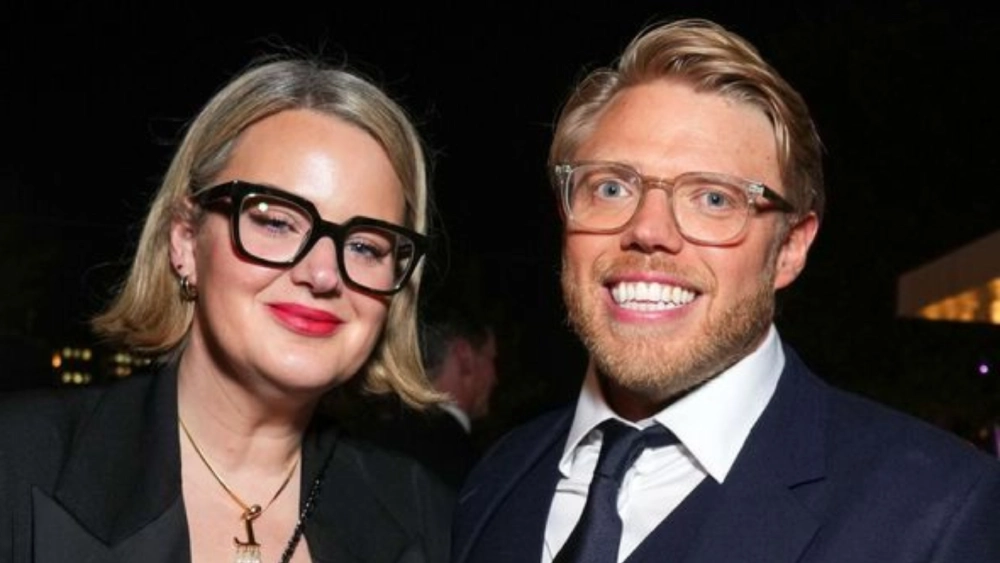
Rob and Lou Beckett married after several years together — they met around 2009, during those earliest and most financially precarious days of his comedy career — and now live in Sevenoaks, Kent with their two daughters. The family home reflects a deliberate choice: comfortable and well-appointed without tipping into the flashy excess that some in entertainment gravitate towards. Desirable properties in Sevenoaks commonly range from £500,000 to well over £1 million, placing the family in a secure but decidedly un-showy bracket.
Lou, the former history teacher who once covered all the bills while Rob chased open-mic slots, has built her own public profile in recent years. She is a regular — and self-described “mostly silent” — participant on the Parenting Hell podcast, and her candid writing about the emotional realities of motherhood struck a powerful nerve with a wide audience. Her blog post “A Very Long Whinge” about the invisible labour of default parenting attracted 56,000 views almost overnight and generated over 116,000 impressions on Instagram.
That response led to a publishing deal with DK RED, and her debut book — Lessons from a Default Parent: Surviving the Front Line of Family Life (Without Losing Your Sh*t) — was released in February 2026. Running to 240 pages, the book tackles the invisible labour that falls disproportionately on one parent in most households, blending humour with genuine insight into the emotional toll of managing a family’s daily logistics. In her author biography, she is described as “a mother of two, ex-secondary school teacher and wife to Rob Beckett” — a quiet reminder of how far both halves of this partnership have come since those early days of empty bank accounts and open-mic uncertainty.
Whippets
Beyond the professional sphere, Beckett is well known for his affection for whippets, which appear regularly across his social media and have become a charmingly distinctive part of his public image. He has also spoken with notable candour about more personal matters — living with ADHD and dyslexia, and battling periods of deep self-doubt and negative thinking even as his career reached its highest points. This willingness to be publicly imperfect, rather than maintaining a carefully curated celebrity image, has deepened his bond with audiences who value honesty over polish.
In recent years, Beckett has spoken about making a deliberate shift in priorities — becoming more selective about which projects he takes on in order to preserve a stable, consistent routine for his daughters. It is a choice that may temper the pace of future wealth accumulation, but one that reflects a broader definition of success than any bank balance can capture.
Will His Net Worth Keep Growing?
The honest answer is: almost certainly, but possibly at a more measured pace than his talent and work ethic might permit — partly by his own conscious choice.
Several factors point towards continued growth. Rob & Romesh Vs continues to be renewed by Sky, delivering a reliable income stream with each new series. Parenting Hell shows no sign of losing momentum; if anything, Lou’s book and the expanding brand around honest family content could open new commercial avenues — spin-off publications, live events, and brand partnerships that leverage the couple’s combined audience. His live stand-up work remains in strong demand, and every new tour represents a significant earnings event.
However, Beckett has made clear that maximising income is not his overriding objective. The comedy industry is full of performers who burn themselves out chasing every available booking, and Beckett appears to be consciously avoiding that pattern. His decision to work more selectively — while remaining consistently active across television, touring, and podcasting — suggests his net worth will grow steadily rather than through dramatic leaps.
The biggest potential accelerators would be an international project — a streaming special, a format sale abroad, or a crossover into a new market — a significant brand partnership, or a return to the largest-scale live touring. Any of these could push his net worth towards the £8–10 million bracket within a few years. But there is no indication that Beckett views such figures as targets worth chasing at the expense of the family stability he has worked hard to build.
Conclusion
Rob Beckett’s £6 million net worth tells the story of a comedian who built his fortune methodically — through relentless live work, smart diversification across television and podcasting, and the financial discipline of channelling everything through a single, well-managed production company. He started with nothing, was carried through the hardest early years by a partner who believed in his talent before the rest of the country caught on, and has reached a level of financial security that most people in entertainment never achieve.
What distinguishes his story, though, is not the money itself but his relationship with it. Beckett has never projected the image of someone driven by wealth. His comedy celebrates the ordinary — the school run, the family holiday, the mate who says something ridiculous over a pint — and his financial choices seem to reflect that same grounded sensibility. He lives well without being extravagant, works hard without being reckless, and appears to measure success by the quality of his family life as much as by the balance sheet of Peggle Productions.