
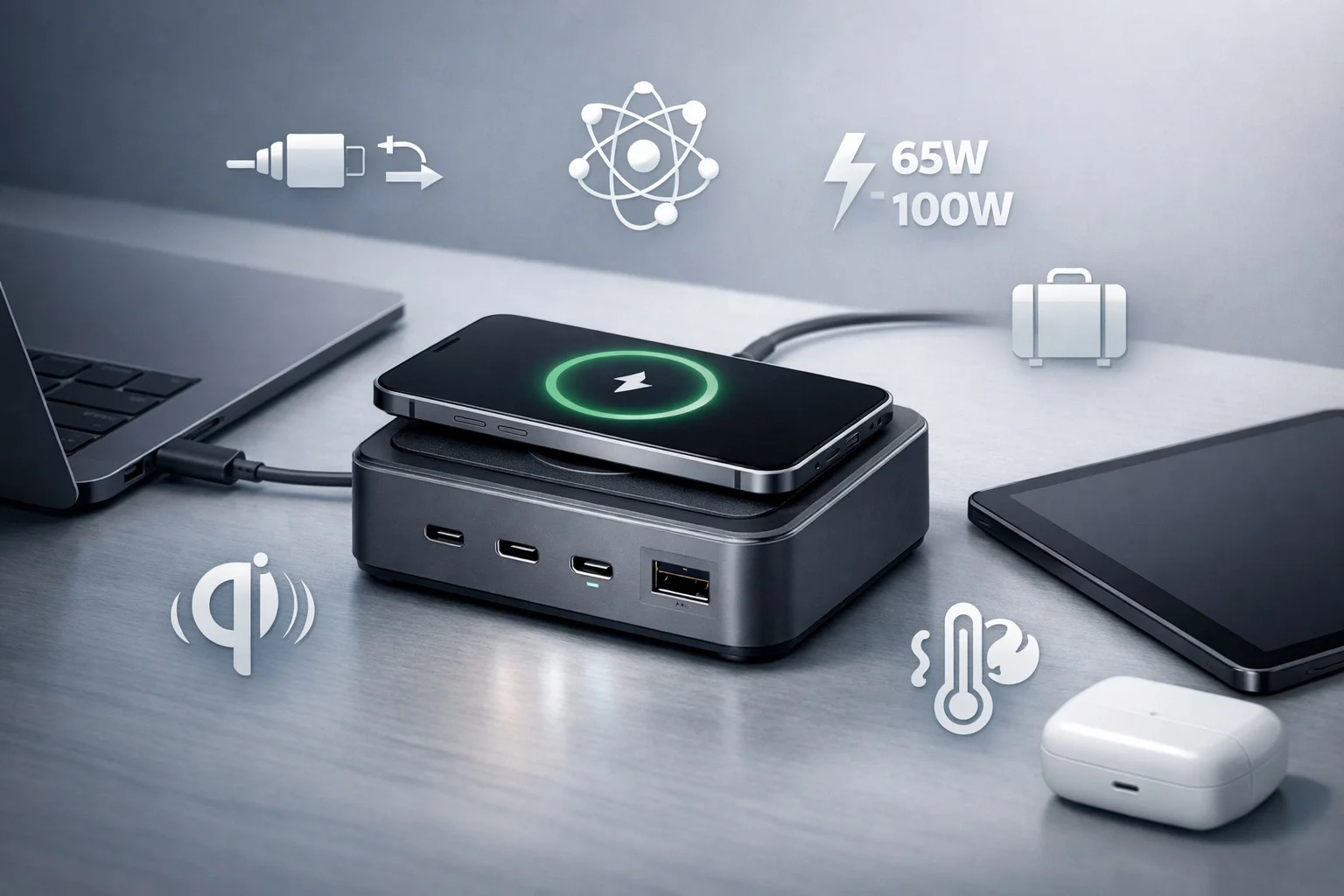
If you’re tired of wrestling with a bag full of oversized power bricks for your laptop, phone, tablet, and wireless earbuds, a single modern USB-C charger might be the answer. Improvements in USB-C Power Delivery, GaN (gallium nitride) semiconductors, and multiport designs have made it possible for one compact charger to replace three or four of the old bricks.
This article explains how a wireless charger, USB-C charger combination can handle everyday needs, what features matter most, and how to choose the right model for travel, home, or office use.
Why USB-C Chargers Are So Much Better Than Power Bricks
Power Delivery (PD) over USB-C supports high wattages and intelligent power negotiation between charger and device. Laptops used to require massive proprietary adapters, while phones needed their own separate charger. Today, a single 65W or 100W USB-C PD charger can charge a laptop at full speed, fast-charge a smartphone, and power accessories — all at once, safely. GaN technology makes these chargers significantly more compact and cooler-running than the silicon-based chargers of the past.
How Modern USB-C Chargers Got So Small and Light
A fast multiport USB-C charger typically includes one or more high-wattage USB-C ports, sometimes a legacy USB-A port, and often a built-in wireless charging surface on top. The charger automatically identifies each device’s voltage and current requirements through PD or Quick Charge protocols. For example, a 65W charger connected to a 15W wireless charging-compatible phone can deliver the full 15W wirelessly, supply around 30W to a connected laptop, and still keep a tablet topped up — all simultaneously. That kind of intelligent distribution removes the need for separate chargers and cuts down considerably on cable clutter.
GaN and Efficiency
GaN transistors operate at higher switching frequencies than traditional silicon, which is what allows manufacturers to shrink the physical size of a charger without sacrificing output. The result is a unit that delivers equal or greater power than older bulky models, but with less heat generation and better overall efficiency. For anyone who travels regularly, that difference in size and weight alone is worth paying attention to.
Wireless Charging Integration
Many USB-C multiport chargers now include a wireless charging pad on top — a pairing that works particularly well on a bedside table or desk. You can set your phone on the pad while the USB-C port handles your laptop. That said, wireless charging support varies between models, so check that the charger supports Qi and, if you own a recent iPhone or Samsung Galaxy device, that it can deliver fast wireless speeds of 10W or 15W.
What to Consider When Choosing a Charger
- Wattage: Match the charger’s total output to the highest power demand among your devices. Most laptops require between 65W and 100W for full-speed charging.
- Ports and Power Distribution: Look for chargers with multiple USB-C PD ports and smart power allocation, so each device still charges efficiently when all ports are in use at the same time.
- Safety Features: Check for over-current, over-voltage, short-circuit, and thermal protection. Chargers that carry third-party safety certifications — such as UL or CE — offer an added layer of confidence beyond the manufacturer’s own claims.
- Form Factor and Weight: For travel, compact GaN chargers under 200 grams that still deliver the wattage you need are the practical choice. Foldable prongs are a small but useful detail worth looking for.
- Compatibility: Confirm the charger supports the protocols your devices actually use — USB-C PD for most modern laptops, Quick Charge for certain Android phones, and standard Qi for wireless charging.
A Real-World Example
When I started testing modern chargers, I replaced three separate bricks — for my laptop, phone, and tablet — with a single 100W GaN USB-C charger that also had a wireless pad built in. The difference was immediate: my bag got lighter, hotel outlets became far less chaotic, and everything charged from a single wall socket. It cleaned up my desk setup, too.
Travel and Home Setup Tips
- Traveling: A slim 65W or 100W GaN multiport charger with foldable prongs and a small carrying pouch keeps things manageable on the road.
- At home: A larger charging station with two high-power USB-C ports and a wireless surface handles a laptop and shared devices without the tangled mess.
Safety and Longevity
Use cables rated for the charger’s maximum output — cheaper cables can slow charging speeds and generate excess heat. PD negotiation handles protection against overcharging automatically, but higher-quality certified chargers in the 50W–100W range reduce risk further. Check cables and connectors periodically for signs of wear before they become a problem.
Conclusion
The right wireless charger, USB-C charger combination can genuinely replace several power bricks and simplify both travel and your everyday setup at home. Pay attention to wattage, port configuration, GaN efficiency, and safety certifications. With the right model, faster charging and a cleaner desk are less about compromise — and more about making one good decision upfront.
FAQs
How do I determine what wattage I need?
Check the original adapter for your laptop and the fast-charge specs for your phone. If you want to charge the laptop at full speed, choose a USB-C charger that matches or exceeds your laptop adapter’s wattage.
Can a USB-C charger charge a laptop and a phone simultaneously?
Yes. Multiport chargers with intelligent power distribution spread wattage across ports, so both devices can charge at the same time. The laptop may charge slightly slower if the combined demand exceeds the charger’s total output.
Are GaN chargers safe?
From reputable brands, yes. They run cooler and more efficiently than older silicon chargers. Look for models with overheat, over-current, and short-circuit protections, along with third-party safety certifications.
Is wired charging faster than wireless?
Generally, yes. Wired fast charging via USB-C is typically quicker than wireless. A multiport unit still supports full wired speeds through its USB-C port while offering convenient wireless top-up for phones when you’d rather skip the cable.
Is one USB-C charger enough for all your devices long-term?
A well-built multiport USB-C PD charger with GaN technology delivering 65W to 100W is a sound investment. As USB-C and PD become standard across more devices and platforms, these chargers are likely to stay relevant for years to come.