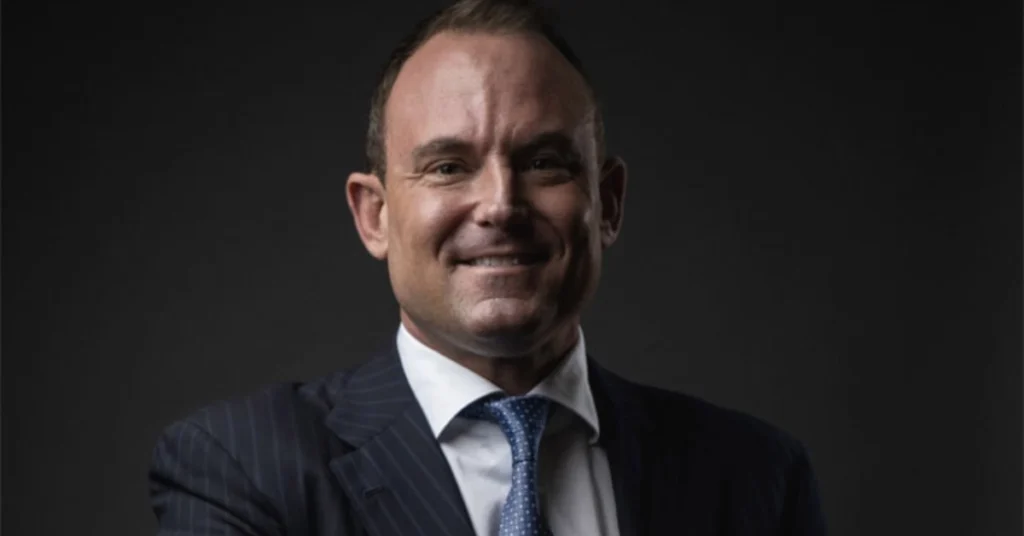
Patrick Carroll built one of the largest multifamily investment platforms in the Sun Belt — without a college degree. From a single apartment deal in Georgia in 2004 to a 28,000-unit, $7 billion vertically integrated operation, his career is a case study in scaling a private real estate company from scratch. After selling his firm’s management platform to The RMR Group for $80 million in 2023, Carroll now operates as a private investor and one of multifamily’s most outspoken market commentators.
What is Patrick Carroll’s Net Worth?
Patrick Carroll’s exact net worth is undisclosed. Estimates place it in the tens of millions. Most of his wealth traces back to CARROLL, the firm he founded in 2004, which handled more than $20.9 billion in acquisitions, developments, and dispositions over nearly two decades.
The largest single liquidity event was the 2023 sale of CARROLL’s operational and property management assets to RMR Group for $80 million in cash. Carroll also retains co-investment and profit share interests in the existing portfolio, which could generate additional value as properties perform. He drew further wealth through distributions during CARROLL’s operating years — the firm returned more than $5 billion to investors over its lifetime, and Carroll was the largest individual stakeholder.
A single net worth figure is hard to pin down. Carroll Holdings, his current investment vehicle, manages a portfolio spanning private equity, real estate, media, and technology — none publicly disclosed. Add in luxury real estate holdings, including a reported $16.4 million Miami Beach residence, and his total wealth likely exceeds any one metric.
Early Life and Entrepreneurial Roots
Born and raised between Richmond, Virginia, and Tampa, Florida, Patrick Carroll gravitated toward business early. He has recalled selling Coca-Colas from his father’s clothing store to passersby at age seven — a first taste of the deal-making that would shape his career. His father’s store sat in a shopping center owned by Tom Shannon, who became Carroll’s most important mentor and a key influence on his business philosophy.
Carroll skipped college. His education came from reading — business books, finance texts, and the Forbes List of Billionaires. That list was a formative influence: the heavy concentration of private equity, hedge fund, and real estate professionals at the top convinced him real estate was the path to lasting wealth. He credits Donald Trump’s early business books with planting the seed for his company’s original name, “Carroll Organization” — though he has since acknowledged that appearances can be deceiving.
Growing up between Richmond’s mid-Atlantic stability and Tampa’s explosive growth gave Carroll an intuitive read on the regional real estate dynamics that would later anchor his investment thesis.
Building the CARROLL Empire
In December 2004, at 27 and with no significant track record, Carroll founded Carroll Organization and began investing in residential properties in Georgia and Florida. Timing was on his side — the mid-2000s real estate boom was accelerating, and Carroll pivoted from residential acquisitions into commercial development: retail shopping centers, mixed-use properties, and student housing.
When the 2008 financial crisis hit, Carroll made a contrarian bet. He sold his development projects at the onset of the downturn and used the proceeds to acquire three property management companies in 2009, instantly building a 20,000-unit management infrastructure. That infrastructure became CARROLL’s core edge: a vertically integrated platform combining capital raising, acquisitions, asset management, and property management under one roof.
The ARIUM Living Brand and Operating Model
CARROLL’s operating strategy centered on ARIUM Living, an in-house residential brand that delivered a consistent resident experience across the portfolio. The brand-driven approach let CARROLL command premium rents while maintaining operational efficiencies at scale.
The business model was “asset light” — rather than owning every property outright, CARROLL collected recurring fees by managing properties held in institutional funds where it carried equity stakes. The structure let CARROLL scale management revenue without a proportional increase in balance sheet risk. By 2023, RMR expected that fee income to exceed $35 million annually.
Headquarters and Geographic Focus
CARROLL is headquartered in Atlanta, placing it at the center of the Sun Belt’s fastest-growing multifamily markets. The geographic focus was deliberate. Carroll recognized early that population migration, job growth, and demographic tailwinds concentrated in Southern and Southwestern metros. The portfolio eventually stretched across major markets in Texas, Florida, Georgia, and the broader Southeast.
CARROLL by the Numbers
The scale of what Carroll built is best understood through the numbers, most disclosed in RMR Group’s investor presentation and press releases around the 2023 acquisition:
- 28,000+ apartment units across 81 properties, primarily in Sun Belt markets
- Approximately $7 billion in assets under management
- $12.8 billion in combined acquisition and disposition volume from 2012 to 2021, encompassing 91,606 total units
- $20.9 billion in total real estate purchased, developed, or sold since inception
- $4.4 billion in total equity raised from institutional and private investors
- $5 billion+ distributed back to investors over the life of the platform
- Nearly 30% average gross realized returns for institutional investors
- 17% average rent growth across the managed portfolio
- 95% occupancy rate at the time of the RMR sale
- 700 employees operating across the platform
- 20+ institutional partner relationships
- More than $3 billion in additional multifamily investment capacity within existing fund series
These figures place CARROLL among the largest privately held multifamily platforms in the United States — built by a 27-year-old with no college degree and no institutional backing.
The $80 Million Sale to RMR Group
In July 2023, after nearly two decades, Carroll decided to sell. RMR Group, a Newton, Massachusetts-based alternative asset management firm led by CEO Adam Portnoy, acquired 100% of the equity interests in MPC Partnership Holdings, LLC — the legal entity operating as CARROLL — for $80 million in cash.
What Was Sold — and What Wasn’t
The scope of the deal matters. RMR acquired CARROLL’s operational and property management platform — the management contracts, the ARIUM Living brand, the 700-person team, the technology infrastructure, and the digital marketing capabilities. The 81 apartment properties, valued at $7 billion, were separately owned by funds in which Carroll held equity stakes and were not part of the purchase.
In other words, RMR bought the engine that managed the portfolio — not the real estate itself.
Deal Structure and Financial Terms
The deal terms reveal the underlying value of what Carroll built:
- Purchase price: $80 million in cash, subject to customary adjustments
- Earnout consideration: Up to an additional $20 million based on future capital deployment
- EBITDA multiple: 11.4x to 13.3x of CARROLL’s recurring 2024 earnings before interest, taxes, depreciation, and amortization — or 6.2x to 7.3x when adjusted for anticipated synergies
- Expected recurring revenue: RMR projected more than $35 million in annual recurring fees from the acquisition, with $11 million to $13 million in adjusted EBITDA including $5 million to $6 million in synergies
- Financial advisor: UBS Group AG advised CARROLL on the transaction
Carroll retained his co-investment and profit share interests in the underlying portfolio.
Why Carroll Decided to Sell
In a pre-sale interview with Bisnow, Carroll framed the decision as strategic: “Smaller players that don’t have great access to capital, I think they’re going to go away. So it was really just a strategic decision based on where I think the world’s going. What I’m trying to do is either scale up, or potentially merge with a partner or sell to a larger group.”
For RMR — which managed over $37 billion across office, medical, and industrial properties — the acquisition filled the only major commercial real estate sector where it lacked presence. The deal pushed RMR’s total assets under management to approximately $44 billion and doubled its private capital AUM to $15 billion.
Adam Portnoy cited CARROLL’s exposure to “favorable demographic tailwinds in high-growth Sun Belt markets,” its “differentiated operational expertise,” and its institutional investor relationships as key drivers.
RMR’s board unanimously approved the transaction. It closed in fall 2023, subject to customary consents from limited partners, joint venture partners, and lenders.
Market Commentary: A Multifamily Expert Watching From the Sidelines
Since departing CARROLL, Patrick Carroll has become one of multifamily’s most candid and widely followed voices — primarily through LinkedIn posts that regularly draw hundreds of comments from institutional investors, fund managers, and operators.
The “Extend and Pretend” Warning
In one of his most widely circulated posts, Carroll explained why he is staying on the sidelines despite two decades of active Sun Belt investing:
“I built $13 billion in Sun Belt multifamily. I’m not touching it right now.”
“Lenders are extending. Sponsors are pretending. Properties are underwater, loans are upside down, and nobody is pulling the trigger. The result is an entire asset class in suspended animation.”
He listed the structural pressures behind his caution: insurance costs in Florida and Texas that are “not negotiable,” operating expenses that don’t pause just because lenders do, cap rate expansion without a matching increase in transaction volume, and — most critically — $200 billion in multifamily debt maturing before the end of 2026.
A Data-Driven Bear Case for Sun Belt Multifamily
In a more recent analysis, Carroll broke down the supply-demand dynamics with the specificity of a 20-year operator:
- Supply glut: Over 600,000 units delivered in 2024, pushing national vacancy to 7.3% — the highest since at least 2017
- Rent declines: Austin rents down approximately 20% from 2022 peaks; Phoenix with half its listings offering a month or more free; Atlanta vacancy doubled to 12%
- Demand erosion: Job growth collapsed in the second half of 2025, falling from 500,000 per month to 193,000; unemployment for the 20–28 renter cohort hit 7.4%; BLS revised job numbers down by 911,000
- Immigration headwind: Net migration forecast down 75% year-over-year — with over 80% of population growth in Dallas and Miami since 2020 coming from international migration
His conclusion: “Patience isn’t sitting on the sidelines. It’s discipline. The operators who win the next cycle will be the ones who didn’t overpay in this one.”
Real-time commentary from a builder of his scale is rare. It has positioned Carroll as a current market voice whose analysis reaches institutional capital allocators directly.
Carroll Holdings and Current Ventures
After leaving CARROLL in 2023, Carroll relocated to Miami and established Carroll Holdings, a private investment firm focused on private equity, real estate, media, and technology — a shift from running a single-sector platform to deploying capital across multiple asset classes.
Specific investments under Carroll Holdings remain undisclosed. Carroll’s public statements, though, point to deliberate diversification away from multifamily — at least until market conditions improve.
Sports and International Investments
Carroll has also expanded into professional sports. He co-owns S.P.A.L., an Italian football club, signaling interest in international deal flow beyond American real estate. Sports franchises have historically appreciated. For Carroll, the investment opens European business networks and a global platform that complements his primarily domestic track record.
Media Presence and Personal Brand
Carroll’s public profile is unusually large for a private real estate operator. His media presence spans multiple channels:
- Instagram: Over 1 million followers
- CNBC: Regular appearances as an expert commentator on the economy and the apartment industry
- LinkedIn: Active posts on multifamily market dynamics, drawing engagement from institutional investors and industry professionals
- The Real Deal Miami Real Estate Forum: Featured speaker in a conversation with founder Amir Korangy covering “ambition, accountability and the art of the comeback”
The mix of traditional media, social media, and industry events has made Carroll one of the most recognizable names in American real estate.
Philanthropy and Community Impact
Carroll has been an active philanthropist, focusing on youth development and early childhood education. His involvement includes:
- Boys & Girls Clubs of America: Carroll has served as a board member of the Tampa Boys & Girls Club, using the role to show students that paths to success exist beyond traditional education
- Charitable donations: Contributions to more than 50 charities worldwide, focused on health, wellness, and early childhood development
- COVID-19 relief: During the pandemic, Carroll donated over $100,000 to feed families in Atlanta and funded meals for frontline hospital workers across multiple facilities
- Motivational speaking: Carroll advocates for physical and mental wellness, encouraging young entrepreneurs to treat health as a business priority
His approach has been hands-on rather than passive check-writing — a style that has amplified his community impact and reinforced his public image.
Controversies and Legal Challenges
Carroll’s rise has been accompanied by public controversies. While his business track record holds, personal incidents have drawn significant media attention.
Restaurant Incidents in Miami
In 2023, Carroll was accused of spitting on a restaurant manager in Miami’s Wynwood neighborhood, an incident first reported by The Real Deal. The manager subsequently filed a defamation lawsuit against Carroll. Additional reports accused him of using a racial slur against an employee at a different Miami restaurant. He was reportedly banned from establishments associated with Major Food Group and restaurateur Simon Kim.
Domestic Abuse Allegations
According to court documents obtained by Bisnow, Carroll was accused of domestic abuse by his ex-wife during their divorce proceedings. A recording surfaced in which he allegedly admitted to physical violence, though the website hosting the recording was subsequently taken down. A Tampa-based divorce attorney who represented Carroll’s ex-wife also filed a defamation lawsuit, alleging that Carroll made false statements about the attorney on social media.
Additional Legal Issues
Other reported incidents include a 2023 Los Angeles arrest on DUI and weapons charges and a 2024 psychiatric evaluation under Florida’s Baker Act following a gun-related incident. These episodes added to the scrutiny around Carroll’s personal life while his professional record continued to earn industry respect.
The timing of the controversies — which intensified around the same period Carroll was exploring the sale of his firm — led to speculation about whether the incidents influenced his decision to exit. Carroll has not publicly drawn a direct connection between the two.
The Art of the Comeback
After a period of public scrutiny, Carroll re-emerged at The Real Deal Miami Real Estate Forum — the first major venue where he directly addressed his personal challenges alongside his business record.
The session, billed as a “no-holds-barred conversation” with founder Amir Korangy, covered “ambition, accountability and the art of the comeback.” LinkedIn has reinforced the comeback arc. His posts draw substantive engagement from fund managers, institutional investors, and operating partners who treat his analysis as market intelligence.
Whether Carroll’s personal rehabilitation matches his professional resilience remains to be seen. The trajectory, though, suggests someone who understands that the best response to controversy is competence — and in real estate, the numbers behind CARROLL carry weight.
What’s Next for Patrick Carroll?
Carroll’s financial position rests on the RMR sale proceeds, his retained co-investment interests in the CARROLL portfolio, and the capital base of Carroll Holdings. His challenge is deploying that capital in a market he has described as treacherous.
His criteria for re-entering multifamily are specific: absorption must outpace deliveries for two or more consecutive quarters, job growth must reaccelerate above 150,000 per month, concessions must decline in actual lease comps (not press releases), and immigration policy must provide demand-side clarity. Until then, patience over urgency.
Carroll’s diversification into private equity, media, technology, and sports points to a long-term vision beyond any single asset class. His track record — $20.9 billion in transactions from a standing start, nearly 30% average returns, and a premium exit — provides the credibility to attract capital and partners going forward.
The operators who win the next cycle, as Carroll has written, “will be the ones who didn’t overpay in this one.” By that measure, he is positioning himself to be one of them.