Dave Chappelle walked away from a $50 million contract at the height of his fame, then spent the next twenty years proving that decision right. Few entertainers get to test that kind of bet. Fewer still win it.
In this article
- Dave Chappelle Quick Facts
- Who Is Dave Chappelle?
- Early Life and Education
- Dave Chappelle’s Career Journey
- Breakthrough with Chappelle’s Show
- Why Did Dave Chappelle Leave Chappelle’s Show?
- Dave Chappelle’s Return to Comedy
- Netflix Comedy Specials
- Dave Chappelle’s Best Movies and TV Shows
- Dave Chappelle’s Comedy Style
- Awards and Achievements
- Dave Chappelle Net Worth
- Personal Life
- Public Image and Controversies
- Latest News and Recent Projects
- Dave Chappelle’s Legacy
- Frequently Asked Questions
- Conclusion
This guide covers who Dave Chappelle is, how he built his career, why he left Chappelle’s Show, his run of Netflix specials through 2026, his family life, his net worth, and the controversies that keep following him onto every stage he steps on.
Dave Chappelle Quick Facts
| Category | Details |
| Full Name | David Khari Webber Chappelle |
| Date of Birth | August 24, 1973 |
| Age | 52 (as of 2026) |
| Birthplace | Washington, D.C. |
| Nationality | American |
| Profession | Comedian, actor, writer, producer |
| Years Active | 1988 to present |
| Wife | Elaine Chappelle (née Mendoza Erfe) |
| Children | Three: Sulayman, Ibrahim, and Sanaa |
| Residence | Yellow Springs, Ohio |
| Famous For | Chappelle’s Show, Netflix stand-up specials |
| Awards | Multiple Emmy Awards, a Grammy Award, the Mark Twain Prize for American Humour |
| Net Worth (estimated) | Reported figures vary widely, from roughly $50 million to $100 million |
| Most Popular Works | Chappelle’s Show, Half Baked, The Closer, The Dreamer, The Unstoppable |
Net worth figures for public figures are rarely confirmed by the individual and often differ between outlets. The range above reflects independent media estimates, not a verified disclosure.
Who Is Dave Chappelle?
Dave Chappelle is one of the most influential stand-up comedians of his generation. He built his name on sharp social commentary, fearless political material, and a storytelling style that turns a single premise into a ten-minute act.
He first reached a mass audience with Chappelle’s Show in the early 2000s, then became something rarer: a comedian who left television at the top of his ratings and came back on his own terms years later. That decision reshaped how audiences and networks think about him. It also became the foundation of a story that gets retold every time he releases something new.
His influence shows up in how other comedians structure long-form sets, in how streaming platforms bid for exclusive specials, and in the ongoing debate about where comedy’s boundaries should sit. Whether people agree with his material or not, his specials consistently become cultural events rather than quiet streaming releases.
Early Life and Education
Chappelle was born in Washington, D.C., to two educators. His father, William David Chappelle III, was a professor, and his mother, Yvonne Seon, worked in academia and diplomacy. After his parents separated, he split his time between Washington, D.C., with his mother and Yellow Springs, Ohio, with his father during summers, the same small town where he lives today.
He attended the Duke Ellington School of the Arts in Washington, D.C., a public high school built around performing arts training, where he studied theatre. Comedy pulled at him earlier than most. At 14, he tried his first open mic. At 15, he bombed badly enough at the Apollo Theater’s amateur night to get booed off stage, an experience he has referenced in interviews as a formative early lesson rather than a setback.
He moved to New York after high school to chase stand-up full time, working clubs and open mics while picking up small television and film roles through the early 1990s.
Dave Chappelle’s Career Journey
Chappelle’s first screen credit came in 1993, in Robin Hood: Men in Tights, followed by supporting parts in films like The Nutty Professor and Con Air. These were minor roles, but they kept him working in front of cameras while he built his stand-up reputation on the club circuit.
His first lead role arrived in 1998 with Half Baked, a stoner comedy he co-wrote that became a cult favorite on home video, even though it underperformed at the box office. Through the late 1990s, he also tried his hand at network television with a short-lived ABC sitcom, Buddies, which was canceled after only a handful of episodes. The setback pushed him back toward stand-up and eventually toward the format that would define his career.
Breakthrough with Chappelle’s Show
Chappelle’s Show premiered on Comedy Central in 2003, co-created with writer Neal Brennan. The sketch series mixed racial satire, pop culture parody, and character work, most famously the Rick James sketches built around Charlie Murphy’s stories and the “Clayton Bigsby” segment about a blind Black white supremacist.
The show became a ratings phenomenon almost immediately. Its second season set a DVD sales record for a television series at the time, and the show turned Chappelle into one of the most quoted comedians in the country. Lines from the series entered everyday conversation in a way few sketch shows have matched since.
Why Did Dave Chappelle Leave Chappelle’s Show?
In 2004, Comedy Central offered Chappelle a reported $50 million deal to continue the show for two more seasons. He walked away from it midway through filming the third season, flying to South Africa without notifying his team in advance.
Chappelle later explained the decision as a response to feeling misunderstood on set, describing a moment during a sketch shoot where a crew member’s reaction to a joke made him question whether the material was landing the way he intended. He has also spoken about the exhausting pace of production and the pressure of sudden fame.
The trip triggered widespread speculation, much of it inaccurate, about his mental health. Chappelle later dismissed most of that coverage directly, framing his exit as a deliberate choice to protect his creative control rather than a breakdown. The show’s third season was released afterwards using unfinished material he did not fully approve, which only deepened public interest in his side of the story.
The walkaway ended his television deal, but it also built the scarcity that would define the next phase of his career. Audiences spent years wondering when, or if, he would come back.
Dave Chappelle’s Return to Comedy
Chappelle stayed largely out of the spotlight for close to a decade, occasionally popping up for surprise club sets that became their own kind of internet legend. He returned to consistent touring around 2013, testing new material in small rooms before building back up to arenas.
By the mid-2010s, he was headlining major tours again and had rebuilt enough momentum to negotiate a landmark deal with a new partner: Netflix. That partnership turned into the defining structure of his second act.
Netflix Comedy Specials
Chappelle’s Netflix deal, signed in 2016, reportedly pays him around $20 million per special, a rate few comedians in history have matched. Since then, he has released eight specials on the platform.
The Age of Spin and Deep in the Heart of Texas launched together in 2017, marking his full return to filmed stand-up after years away. Equanimity and The Bird Revelation followed in 2019, paired specials recorded on the same night that showed a more reflective side of his writing alongside his usual political material.
Sticks & Stones arrived in 2019 and became one of his most-watched specials, tackling cancel culture and celebrity scandal with material that split critics and audiences. The Closer, released in 2021, drew heavy backlash for its jokes about transgender people and led to a public walkout among Netflix employees, even as it won the Grammy Award for Best Comedy Album in 2023.
What’s in a Name?, a 2022 commencement address turned Netflix special, showed a different register: sincere, reflective, built around a speech he gave at his old high school. The Dreamer followed in 2023 and topped Netflix’s own viewership rankings for the first half of 2024.
His most recent release, The Unstoppable, dropped without warning in December 2025, right after a major boxing match aired that same night. Filmed in Washington, D.C., his hometown, it became his eighth Netflix special and again led Netflix’s biannual viewership report for stand-up, pulling in roughly 14 million views in its first weeks. The special covers his appearance at the Riyadh Comedy Festival and the criticism that followed, alongside material on censorship and current events.
Across nearly a decade, the Netflix partnership has turned Chappelle’s specials into recurring cultural moments rather than routine content drops, each one arriving with almost no warning and immediately dominating conversation.
Dave Chappelle’s Best Movies and TV Shows
Beyond stand-up, Chappelle has built a varied film and television resume. Early supporting roles in Robin Hood: Men in Tights, The Nutty Professor, and You’ve Got Mail gave him visibility before Half Baked made him a lead. Undercover Brother followed in 2002, giving him a starring comedic role outside the stoner genre.
His later film work leaned more dramatic. Spike Lee’s Chi-Raq (2015) and Bradley Cooper’s A Star Is Born (2018) showed a quieter, more restrained side of his acting, a contrast to the high-energy persona audiences know from stand-up. He has also made frequent guest appearances on Saturday Night Live, including a memorable post-election hosting stint in 2016 that drew some of the show’s highest ratings in years.
Dave Chappelle’s Comedy Style
Chappelle’s stand-up leans on long, layered stories more than quick one-liners. A typical set builds a premise slowly, circles back to it from a different angle, then resolves it with a punchline that reframes everything that came before.
His material draws heavily on race relations, American politics, and pop culture, often filtered through a specific personal anecdote rather than a generic observation. That specificity is part of why his sets feel distinct from typical topical comedy. He has also become known for direct, unfiltered commentary on hot-button social issues, a habit that has earned him both loyal audiences and sustained criticism in roughly equal measure.
His delivery style, unhurried pacing paired with sudden bursts of intensity, has influenced a generation of comedians who now build their own specials around similar long-form storytelling rather than rapid-fire jokes.
Awards and Achievements
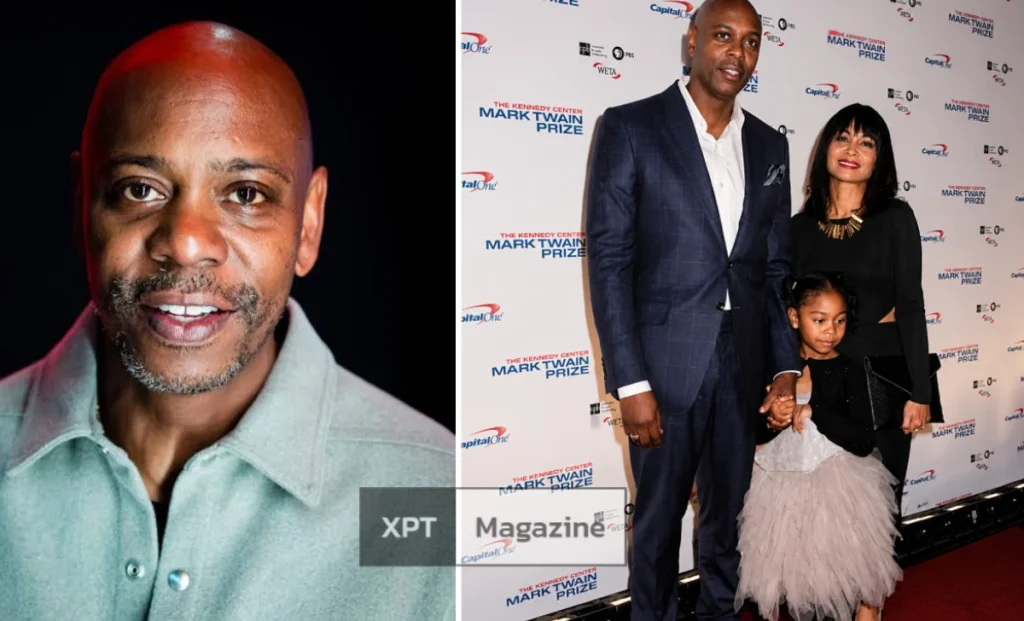
Chappelle has won multiple Emmy Awards for his Netflix specials, along with a Grammy Award for Best Comedy Album for The Closer in 2023. In 2019, the Kennedy Centre awarded him the Mark Twain Prize for American Humour, the top honour in American comedy, previously given to figures like Richard Pryor and George Carlin. In 2025, he received the NAACP President’s Award, recognising his broader cultural contributions.
Dave Chappelle Net Worth
Estimates of Dave Chappelle’s net worth vary significantly across outlets, ranging from roughly $50 million on the lower end to around $100 million on the higher end, depending on how each source values his Netflix deal, touring income, and older television royalties. No confirmed figure has been publicly disclosed by Chappelle himself.
What is better documented is where the money comes from. His Netflix specials reportedly pay around $20 million each, and he has released eight of them since 2017. Touring adds a second major income stream, with ticket prices for his arena shows regularly running from $150 to over $400 depending on market and seating. Older residual income from Chappelle’s Show, still one of the most-watched sketch series in syndication history, continues to contribute as well. His acting work in film and television adds a smaller but steady third stream.
Personal Life
Chappelle has been married to Elaine Chappelle, formerly Elaine Mendoza Erfe, since 2001. The two met in Brooklyn before his career took off, and Chappelle has said publicly that she supported him through his leaner years. They have three children together: sons Sulayman and Ibrahim, and daughter Sanaa.
The family relocated to Yellow Springs, Ohio, in 2006, where Chappelle owns a working farm and has said the small-town setting lets his children grow up largely outside the public eye. He has described the community as protective of his family’s privacy, a contrast to the constant attention he receives on tour and in interviews.
Public Image and Controversies
Chappelle has spent much of the last decade at the centre of debates about comedy and free speech. The Closer, his 2021 Netflix special, drew significant criticism for jokes about transgender people and prompted an organized walkout by Netflix employees, along with public statements from LGBTQ advocacy groups. Chappelle has defended the material as satire aimed at a broader point about cancel culture, while critics have argued it crossed from satire into direct harm.
In 2022, he was physically attacked on stage during a set at the Hollywood Bowl, an incident he addressed directly in later material. More recently, his 2025 appearance at the Riyadh Comedy Festival in Saudi Arabia drew criticism from human rights organisations and fellow comedians over the country’s human rights record. Chappelle addressed the backlash himself in The Unstoppable, arguing that outrage over his participation felt selective compared to other global issues.
Through all of it, Chappelle has generally responded the same way: doubling down on the material in his next special rather than walking it back, a pattern that has become part of his public identity as much as the jokes themselves.
Latest News and Recent Projects
Chappelle closed out 2025 with The Unstoppable, a surprise Netflix release filmed in Washington, D.C., that became his top-performing special of the year on the platform. He followed it with a run of shows at the Netflix Is a Joke festival in Los Angeles in early 2026.
In June 2026, he announced a limited five-city arena tour, opening in Baltimore and running through Detroit, Cleveland, Chicago, and San Diego, with all shows enforcing a phone-free policy using locked pouches for the audience. He has also mentioned interest in reviving elements of Chappelle’s Show, floating the idea of Eddie Murphy stepping into segments originally built around his late brother, Charlie Murphy.
Dave Chappelle’s Legacy
Chappelle’s influence on stand-up runs deeper than any single special. He helped popularise the long-form storytelling style that now defines much of modern comedy, and his decision to walk away from Chappelle’s Show remains one of the most studied moves in entertainment history, a case study in choosing creative control over a guaranteed payday.
Almost twenty years after he left network television, he remains one of the few comedians whose new release is treated as a genuine cultural event rather than routine content.
Frequently Asked Questions
How old is Dave Chappelle?
Chappelle was born on August 24, 1973, making him 52 years old as of 2026.
What is Dave Chappelle’s net worth?
Estimates vary widely across outlets, generally ranging from around $50 million to $100 million. No verified figure has been publicly confirmed.
Who is Dave Chappelle’s wife?
He has been married to Elaine Chappelle, née Mendoza Erfe, since 2001. The couple met in Brooklyn before his career took off.
Does Dave Chappelle have children?
Yes, three children: sons Sulayman and Ibrahim, and daughter Sanaa.
Why did Dave Chappelle leave Chappelle’s Show?
He walked away from a reported $50 million deal in 2005 during production of the show’s third season, citing creative disagreements and the pressure of the show’s rapid success.
Where does Dave Chappelle live?
He lives in Yellow Springs, Ohio, where he has owned a farm since relocating there in 2006.
What are Dave Chappelle’s best Netflix specials?
Sticks & Stones, The Closer, and The Dreamer rank among his most-watched and most-discussed specials, alongside his most recent release, The Unstoppable.
How many Grammy Awards has Dave Chappelle won?
He has won one Grammy Award, for Best Comedy Album, for The Closer in 2023.
What movies has Dave Chappelle appeared in?
His film credits include Half Baked, Undercover Brother, Chi-Raq, and A Star Is Born, alongside earlier supporting roles in Robin Hood: Men in Tights and The Nutty Professor.
Is Dave Chappelle still performing?
Yes. He released a new Netflix special in December 2025 and announced a five-city arena tour for June 2026.
Conclusion
Dave Chappelle’s career is really the story of one decision made twice: walking away from Chappelle’s Show in 2005, then walking back into stand-up on terms only he controlled. That pattern, stepping back from guaranteed success to protect creative independence, now defines everything from his Netflix deals to his approach to controversy. Whatever comes next, it will likely arrive the way his last few specials have: without warning, and immediately impossible to ignore.