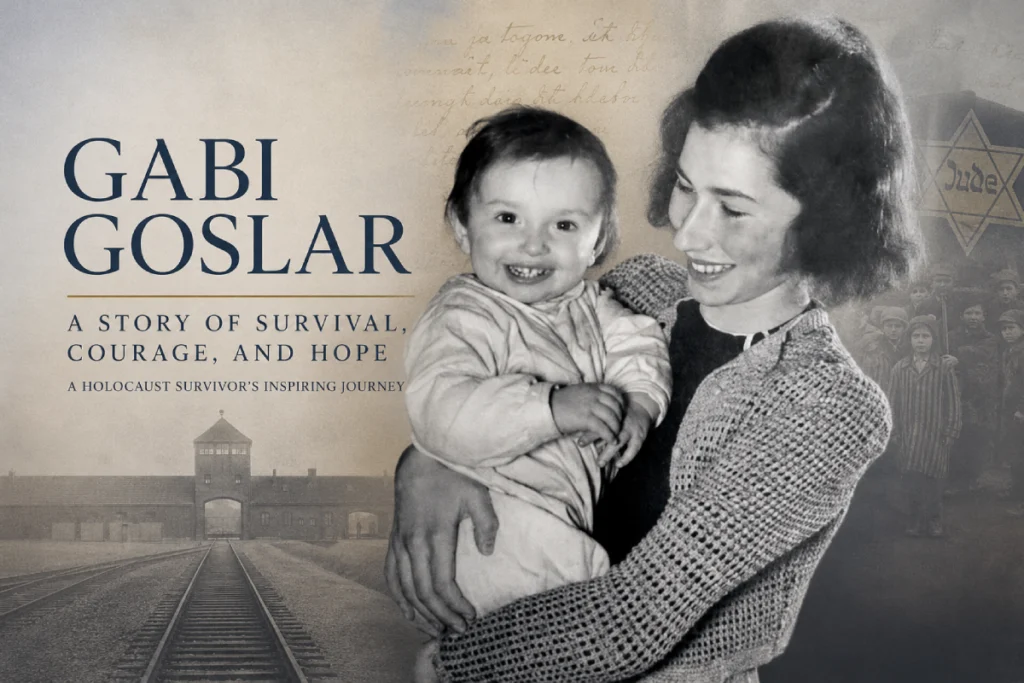
Introduction: Who Was Gabi Goslar?
Gabi Goslar was a Holocaust survivor. She endured imprisonment in Bergen-Belsen concentration camp and survived the infamous “Lost Train” — all before her fifth birthday. Gabi was born Rachel Gabriela Ida Goslar on October 25, 1940, in Amsterdam. She was the younger sister of Hannah Pick-Goslar, the childhood best friend of Anne Frank.
History has rightfully preserved Anne Frank’s diary and Hannah’s remarkable survival story. But Gabi’s own journey through the Nazi camp system deserves recognition too. She was a child born into war. The Nazis deported her alongside her family, and she became one of the very few young children who survived the camp system’s final, chaotic months.
Much of what we know about Gabi comes not from her own public testimony, but from Hannah’s. Hannah shared it through interviews, her 1997 memoir, and the 2023 book My Friend Anne Frank, written with Dina Kraft. Gabi herself kept a comparatively private life. Reliable, independently verified information about her adulthood remains limited. This account sticks to what we can document, and it says plainly where the record runs out.
Early Life in Amsterdam: A Childhood Before the Storm
A Family Seeking Refuge from Nazi Germany
The Goslar family had deep roots in German Jewish life. Gabi’s father, Hans Goslar, worked as a journalist and civil servant. He served as deputy minister for domestic affairs and headed the press office in the Prussian state government during the Weimar Republic. Gabi’s mother, Ruth Judith Klee, came from a respected Jewish family and worked as a teacher.
Adolf Hitler became Chancellor in 1933, and the new government forced Hans Goslar to resign his post almost immediately. The family first tried to settle in London. Hans, an observant Jew, struggled to find work there that would let him keep the Sabbath. Later that year, they relocated to Amsterdam instead and settled at Merwedeplein, close to the Frank family.
In Amsterdam, Hannah — the eldest daughter — formed her famous friendship with Anne Frank. The two girls met while grocery shopping with their mothers in 1934. They later attended the same Montessori school together. Hannah recalled the friendship beginning simply, over a shared errand and a shy introduction that grew into an inseparable bond.
Gabi was born into this refugee household on October 25, 1940. The family had already been uprooted once by the time she arrived, and their new life of relative safety would not last much longer.
The Nazi Occupation of the Netherlands
Nazi Germany invaded the Netherlands in May 1940. The country surrendered within days. Restrictions followed quickly: curfews, forced registration, the mandatory yellow Star of David, and the systematic removal of Jews from schools, businesses, and public life.
Gabi was born just months before the occupation began, so these restrictions simply became the world as it was for her. She never knew Amsterdam any other way. Her older sister could still remember some freedom from early childhood. For Gabi, that freedom was already gone by the time she was old enough to notice.
How Did Gabi Goslar’s Parents Die?
Loss Before the Camps
Ruth Goslar died in 1942 while giving birth to her third child. The baby was stillborn. Gabi was not yet two years old. Hans Goslar now had to raise his two daughters alone in an increasingly dangerous city.
On June 20, 1943, the Nazis carried out a major roundup in Amsterdam. They arrested Hans Goslar, his two daughters, and Ruth’s parents — Gabi’s maternal grandparents, Alfred and Therese Klee. The Nazis sent them all to the Westerbork transit camp in the northeastern Netherlands. The family held Paraguayan passports and papers connected to Mandatory Palestine, so they qualified for the camp’s “exchange Jews” list. That status let them remain at Westerbork for roughly eight months, unusually long, before deportation onward. Gabi’s grandfather, Alfred Klee, died at Westerbork in November 1943.
In February 1944, the Nazis deported the family to Bergen-Belsen concentration camp in Germany. Hans Goslar died there on February 25, 1945, from illness and exhaustion brought on by the camp’s conditions. Gabi’s grandmother, Therese Klee, died at Bergen-Belsen the following month. German and Dutch Holocaust memorial records document both deaths. A Stolperstein, or memorial stone, marks the family’s former Berlin address today.
Hannah and Gabi were now without both parents and both grandparents. They would be the only members of their immediate family to survive the war.
Imprisonment in Bergen-Belsen: Surviving the Unsurvivable
Life in the Camp
Bergen-Belsen was one of the most notorious camps in the Nazi system. By the winter of 1944–45, its conditions had collapsed into starvation, disease, and severe overcrowding as the camp absorbed prisoners evacuated from farther east. The family’s “exchange” status placed Hannah and Gabi in a somewhat more privileged section of the camp. But even “privileged” at Bergen-Belsen still meant hunger, illness, and constant loss.
Hannah and Gabi endured roughly fourteen months at Bergen-Belsen in total. Gabi turned four there in October 1944. A child so young depended almost entirely on her older sister to survive. Hannah, only sixteen herself, took on a caretaking role well beyond her years.
Most very young children did not survive Bergen-Belsen. That Gabi did is remarkable. It reflects both her own resilience and the extraordinary effort Hannah made to keep her alive.
Did Anne Frank and Hannah Goslar Reunite?
The Fence Between Hope and Heartbreak
One of the most poignant moments in Holocaust history is the final meeting between Hannah Goslar and Anne Frank at Bergen-Belsen.
By late 1944, the Nazis had transferred Anne and her sister Margot to Bergen-Belsen from Auschwitz. A barbed-wire fence divided the camp, and Anne ended up in a less privileged section than Hannah and Gabi. Sometime between January and February 1945, Hannah learned Anne was nearby. She went to the fence at night to find her.
Hannah and Anne spoke at the fence on three occasions. Hannah tried to throw a package of food over the barbed wire the first time, but another prisoner intercepted it before Anne could reach it. On a later attempt, Anne did receive a package of bread and socks. It became the last exchange between the two friends. Anne died at Bergen-Belsen in early March 1945, likely of typhus, just weeks before the camp’s liberation.
Gabi was too young to remember these encounters clearly in later life. But through Hannah’s testimony, Anne Frank became a real and lasting presence in the family’s story — not just a name in a published diary, but someone Hannah had risked her own safety to reach.
The “Lost Train”: Liberation Against All Odds
A Harrowing Journey to Freedom
In April 1945, as Allied forces closed in, the SS evacuated roughly 2,500 “exchange” prisoners from Bergen-Belsen by train, including Hannah and Gabi. The train was ostensibly bound for Theresienstadt. Conditions on board were brutal. Prisoners were crammed into open or barely provisioned cars with almost no food or water, and the train never reached its intended destination.
The journey lasted about two weeks. Many died of starvation, exposure, and disease along the way. Survivors came to call it the “Lost Train.” Soviet forces finally halted it near the villages of Tröbitz and Schilda in Germany and liberated the prisoners in late April 1945.
Gabi, not yet four and a half, was severely malnourished. By some accounts she weighed under 20 pounds, and she required extensive medical care to survive. Hannah had also contracted typhus during the ordeal but recovered. The sisters found temporary shelter with the mayor of Schilda. Soviet and later American authorities then helped arrange their return to the Netherlands, where doctors hospitalized Hannah until the end of September 1945.
A note on sourcing: Some online accounts describe a stay in a Dutch orphanage after the war and a specific visit from Otto Frank in July 1945. We could not verify these details against reliable Holocaust archives or Hannah’s own published account. Hannah’s account instead describes her taking on guardianship of Gabi directly after their return. Readers should treat that specific orphanage claim with caution until someone identifies a primary source.
Life After the Holocaust: Rebuilding in Israel
A New Beginning
At the end of 1945, doctors sent Hannah to a sanitarium in Switzerland to recover, and she finished school in Basel. In May 1947, she received a certificate to emigrate to Mandatory Palestine and arrived there that same month. She trained as a pediatric nurse in Jerusalem and worked at Bikur Cholim Hospital.
Hannah married Dr. Walter Pinchas Pick and settled in Jerusalem, where they raised three children. By the time of her death, she had eleven grandchildren and more than 31 great-grandchildren. She often described her large family, in her own words, as “my answer to Hitler.” Hannah went on to speak publicly and extensively about her friendship with Anne Frank and her Holocaust experience for the rest of her long life. She died at her home in Jerusalem on October 28, 2022, at age 93.
Reliable, independently sourced detail about Gabi’s own adult life remains limited. We know she also emigrated to Israel, and Hannah’s obituaries consistently note that the two sisters were the only members of their immediate family to survive the war. Beyond that, much of what circulates online about Gabi’s later life, marriage, career, or the specific year of her death lacks corroboration from primary sources or established news reporting. This article does not repeat those unverified details as fact.
Preserving History: The Sisters’ Legacy
Sharing the Story
Hannah shared her memories widely over more than six decades. She appeared in documentaries including The Last Seven Months of Anne Frank (1988) and Anne Frank Remembered (1995), and she contributed to Alison Leslie Gold’s 1997 book Memories of Anne Frank: Reflections of a Childhood Friend. In 2023, Hannah published her own memoir, My Friend Anne Frank: The Inspiring True Story of Best Friends Torn Apart and Reunited Against All Odds, written with journalist Dina Kraft. It stands as the fullest account of her life and Gabi’s earliest years, told in her own words.
Hannah spoke often about why she kept telling her story late into her life: because, as she put it, she had survived and Anne had not. Through that testimony, Gabi’s own childhood has also been preserved for history — the loss of her parents, the imprisonment at Bergen-Belsen, the desperate survival of the Lost Train — even where Gabi’s own voice remains less publicly documented than her sister’s.
Conclusion: What the Goslar Sisters’ Story Teaches Us Today
The story of Gabi and Hannah Goslar is one of survival, sisterhood, and the fragile thread that sustained both of them through the worst conditions imaginable.
The power of sisterhood: By every account, Gabi’s survival depended on Hannah. As a teenager, Hannah took on the role of parent, protector, and guardian for a sister not yet five years old. Their bond became the lifeline that got them both out of Bergen-Belsen alive.
Bearing witness matters, even secondhand: Gabi never built a public platform the way Hannah did. So most of what we reliably know about her childhood survives through her sister’s testimony instead. That doesn’t make her story less real. It’s a reminder of how much Holocaust history depends on the witnesses who did choose to speak.
Caution matters in how we tell these stories: Many online accounts about Gabi Goslar contain confident-sounding details — specific memoirs, specific post-war addresses, a specific date of death. These claims don’t hold up against primary Holocaust archives or Hannah’s own published account. Getting the facts right isn’t a formality here. It’s part of honoring the people the story is actually about.
Gabi Goslar was a daughter who lost her parents and grandparents before she turned five. She was a sister who survived because another child, not yet grown herself, refused to let go of her. Her documented story stands verified against Holocaust archives, memorial records, and her sister’s own testimony. It remains a small but important thread in the history of the Holocaust’s youngest survivors.