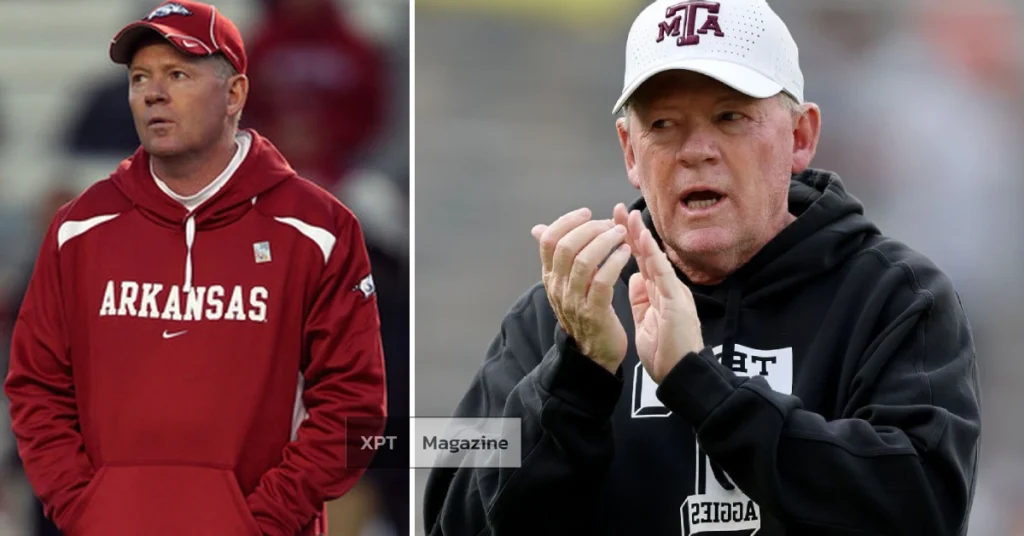
Few names in college football spark as much debate as Bobby Petrino. His offensive schemes have produced some of the most dynamic attacks in the sport. His exits have been just as memorable, though for different reasons. How does someone lose a head coaching job twice yet keep getting hired back? The answer lies somewhere between raw talent and calculated risk.
Who is Bobby Petrino?
Bobby Petrino is an offensive-minded football coach born in 1961 in Lewisburg, West Virginia. He grew up around the game. His father, Bob Petrino Sr., coached high school football, which meant Bobby spent his early years around playbooks and practice fields. He played quarterback at Carroll College in Montana before transitioning into coaching. Over three decades, he’s held head coaching positions at Louisville, Arkansas, Western Kentucky, and briefly with the NFL’s Atlanta Falcons. His reputation? A master at designing explosive offenses. His career arc? Complicated by controversy and marked by comebacks.
Early Life and First Steps Into Coaching
Growing up in a coaching family shaped Petrino’s understanding of the game from childhood. His father instilled discipline and football fundamentals early on. After his playing days at Carroll College ended, Petrino moved directly into coaching. He started as a graduate assistant at Weber State in 1983, then worked his way through assistant positions at Idaho, Nevada, and Arizona State. By the late 1990s, he’d earned a reputation as a sharp offensive coordinator. His quarterbacks improved. His offenses scored points. Programs noticed.
Breakthrough at Louisville
Petrino took over as head coach at Louisville in 2003. The program had been middling. Within three years, he’d transformed it into a national contender. The Cardinals averaged over 30 points per game under his watch. In 2004, they finished 11-1 and ranked sixth in the nation. Two years later, Louisville went 12-1, with quarterback Brian Brohm throwing for over 4,000 yards. That 2006 season showcased everything Petrino did well: quick tempo, creative formations, and an ability to maximize talent. His offense became a model that other programs tried to copy.
2006 Season Highlights
The Cardinals beat West Virginia in the highest-scoring game in college football history, 44-34. They nearly made it to a BCS bowl. Scouts started paying attention to Petrino’s schemes. NFL teams came calling.
A Brief NFL Stop: The Atlanta Falcons
In 2007, Petrino jumped to the NFL to coach the Atlanta Falcons. The move seemed logical. He’d proven he could design offenses at the college level. Why not the pros? The experiment lasted 13 games. The Falcons went 3-10 before Petrino resigned with three games left in the season. He left a note in each player’s locker instead of addressing the team directly. That departure damaged his reputation. Players felt abandoned. The media labeled him a quitter. He returned to college football with a stain on his résumé.
Arkansas Arrival — Success and Controversy
Petrino landed at Arkansas in 2008. The Razorbacks needed an offensive spark. He provided it immediately. Over four seasons, Arkansas won 34 games. They appeared in four straight bowl games. In 2011, the team finished 11-2 and ranked fifth nationally. Quarterback Tyler Wilson flourished. Running back Knile Davis rushed for over 1,000 yards. The program felt positioned for sustained success.
Then came April 2012.
2012 Motorcycle Incident
Petrino crashed his motorcycle on a rural Arkansas highway. He initially claimed he was alone. The truth came out within days. Jessica Dorrell, a 25-year-old volleyball player he’d recently hired as a football staff member, had been riding with him. The two were having an affair. Petrino had also given Dorrell $20,000 in cash and failed to disclose the relationship when he hired her. Arkansas athletic director Jeff Long fired him for cause, citing a pattern of misleading behavior and a violation of university policy.
The Fallout: Firing and Public Reaction
The firing dominated sports media for weeks. Long held a press conference and detailed Petrino’s dishonesty. Fans split into camps. Some focused on his on-field success and wanted him back eventually. Others felt the betrayal ran too deep. Players had to adjust to a new coaching staff mid-recruitment cycle. Petrino issued a public apology but disappeared from coaching for the rest of 2012. His career looked finished.
Rebuilding: Jobs After Arkansas
Petrino didn’t stay away long. In 2013, he returned to his roots, taking over as head coach at Western Kentucky. The Hilltoppers had gone 0-12 the previous season. By his second year, they won the Conference USA championship. That success brought him back to Louisville in 2014. His second stint there lasted four years, with mixed results. The Cardinals went to bowl games but never recaptured the magic of their first run. He moved on to Missouri State in 2020, then took the offensive coordinator job at UNLV, and eventually Texas A&M Commerce. Each stop reinforced one truth: programs would hire him if they believed his offense could win games.
Coaching Style & Strengths
Petrino runs a fast-paced, no-huddle system built around quick reads and spacing. His quarterbacks learn to process defenses rapidly. He uses motion and formation shifts to create confusion before the snap. Running backs receive the ball in space, not into crowded lines. The philosophy demands precision. Players either adapt or get benched. When it works, defenses struggle to keep up. His offenses consistently rank near the top in yards and points. Coaches across the country study his play scripts. That offensive mind keeps him employed despite the baggage.
Return to Arkansas & Latest Role
In 2023, Arkansas brought Petrino back as offensive coordinator. The hire surprised many. Head coach Sam Pittman defended the decision, saying the program needed offensive firepower. Petrino worked behind the scenes, rebuilding relationships and avoiding the spotlight. The offense showed improvement, though results remained inconsistent. Then, in September 2025, Pittman was fired mid-season. Arkansas named Petrino interim head coach. The move closed a 13-year circle. Whether he’ll remain beyond the season remains unclear. For now, he’s back where the biggest chapter of his career unfolded.
Legacy: How to Judge Bobby Petrino?
Judging Petrino means holding two truths at once. He designs offenses better than most coaches alive. He’s also made decisions that cost him jobs and trust. Players who’ve worked with him often praise his football IQ. Administrators who’ve fired him cite ethical lapses. Fans debate whether talent outweighs character. History will likely remember him as a complicated figure: brilliant on the field, flawed off it. Programs keep hiring him because winning matters. They just hope the wins come without the headlines. For now, Petrino remains a working coach, still chasing the redemption story he’s been writing since 2012.